
Logic Supply ML100G-50 Fanless Skylake vPro Industrial NUC Review
Power Consumption and Thermal Performance
The power consumption at the wall was measured with a 1080p display being driven through the HDMI port. In the graphs below, we compare the idle and load power of the Logic Supply ML100G-50 with other low power PCs evaluated before. For load power consumption, we ran the AIDA64 System Stability Test with various stress components, as well as our custom Prime95 / Furmark stress routine, and noted the maximum sustained power consumption at the wall.
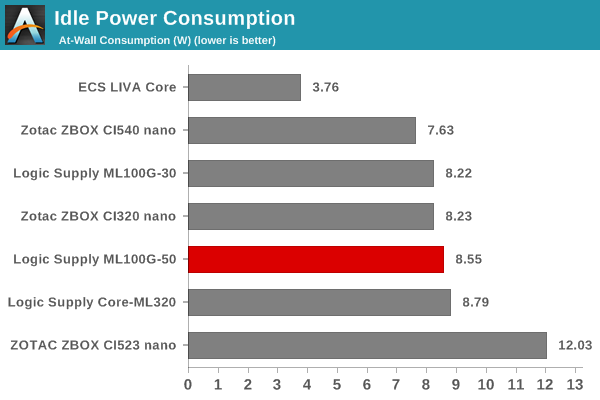
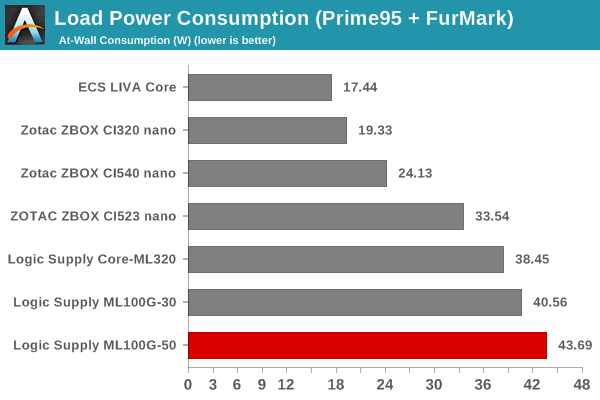
The power consumption numbers are typical of a fanless system sporting a 15W TDP processor. The addition of extra board components such as the USB 3.1 Gen 2 bridge chip (and the overall migration from a standard Intel NUC board to the ASRock Beebox one) makes the ML100G-50 idle at higher power levels compared to the ML100G-30. On the full loading side, it is interesting to note that the ML100G-50 is able to sustain a higher power draw compared to the ML100G-30.
Our thermal stress routine starts with the system at idle, followed by four stages of different system loading profiles using the AIDA64 System Stability Test (each of 30 minutes duration). In the first stage, we stress the CPU, caches and RAM. In the second stage, we add the GPU to the above list. In the third stage, we stress the GPU standalone. In the final stage, we stress all the system components (including the disks). Beyond this, we leave the unit idle in order to determine how quickly the various temperatures in the system can come back to normal idling range. The various clocks, temperatures and power consumption numbers for the system during the above routine are presented in the graphs below.


The AIDA64 system stability test uses real-world workloads to stress the system components. However, power virus tests such as the Prime 95 torture test and Furmark stability test can subject the system to greater stress. We repeated our thermal stress routine with 30 minutes of Prime 95 (v28.10), followed by 30 minutes of Prime 95 and Furmark (1.18.2). The Prime 95 load was then removed, and the GPU stressing Furmark test was allowed too run for another 30 minutes. The various clocks, temperatures and power consumption numbers for the system during the above routine are presented in the graphs below.


The two thermal stress routines reveal that the Core i5-6300U starts off with a 20W allowance for the package power consumption. Based on the workload, the thermal design appears to be able to handle it for around 15 - 20 minutes before the power throttling kicks in. The throttling kicks in when the package temperature reaches around 80C. The AVX instructions in Prime 95 tend to stress one part of the die, causing a more rapid rise in temperature, while the AIDA system stability test is more generic. Despite consuming 20W in both cases, the temperature reaches 80C faster with Prime 95. This causes the system to shift down to the 15W level earlier with the custom stress workload.
Another important aspect to keep note of while evaluating fanless PCs is the chassis temperature. Using the Android version of the FLIR One thermal imager, we observed the chassis temperature after the CPU package temperature reached the steady state value in the above graph. Similar to the ML100G-30, the ML100G-50 also ends up with a chassis temperature of around 67C after being subject to our thermal stress routines.

We have additional thermal images in the gallery below.


The thermal design of the ML100G-50 is very similar to that of the ML100G-30. Therefore, it is no surprise that the thermal profile for both systems under stress are almost the same. All in all, Logic Suply's chassis design ensures that the ML100G-50 is able to operate the CPU package at higher than the rated power numbers for an extended duration before falling back to the expected 15W levels.
Originally published at https://www.anandtech.com/show/11141/logic-supply-ml100g50-fanless-skylake-vpro-industrial-nuc-review (Wayback Machine).