
865PE/875P Motherboard Roundup June 2003 - Part 1: 20-way Shootout
- Posted in
- Motherboards
ABIT IC7-G
|
Motherboard Specifications |
|
|
CPU
Interface
|
Socket-478
|
|
Chipset
|
Intel
82875P MCH (North Bridge)
Intel 82801ER ICH5R (South Bridge) |
|
Bus
Speeds
|
up
to 412MHz (in 1MHz increments)
|
|
Core
Voltages Supported
|
up
to 1.925V (in 0.025V increments)
|
|
I/O
Voltages Supported
|
N/A
|
|
DRAM
Voltages Supported
|
up
to 2.80V (in 0.05V increments)
|
|
Memory Slots
|
4 184-pin
DDR DIMM Slots
|
|
Expansion Slots
|
1 AGP
8X Slot
5 PCI Slots |
|
Onboard IDE RAID
|
N/A
|
|
Onboard USB 2.0/IEEE-1394
|
Eight
USB 2.0 ports supported through South Bridge
TI TSB43AB23 IEEE-1394 FireWire Controller (up to 3 ports total) |
|
Onboard LAN
|
Intel
PRO/1000CT Gigabit LAN (CSA bus)
|
|
Onboard Audio
|
Realtek
ALC650 codec
|
|
Onboard Serial ATA
|
Two
SATA connectors via Silicon Image 3112A Controller (RAID 0, 1, & 0 + 1)
Two SATA connectors via ICH5R (RAID 0 & RAID 1 only) |
|
BIOS
Revision
|
Rev.
13 (5/19/2003)
|
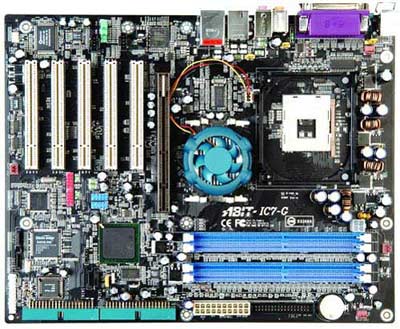
One of the more impressive features the IC7-G brings to the table is excellent Serial ATA and IDE drive support. With two standard Primary/Secondary IDE connectors and four Serial ATA connectors (via Silicon Image 3112A controller and ICH5R) the ABIT IC7-G is capable of supporting four SATA as well as four IDE drives for a grand total of eight possible drives. While most desktop users will find this feature to be nice instead of necessary there will always be those who desire this capability for something a little more potent than everyday desktop usage.
Another interesting feature of note is the TI TSB43AB23 IEEE-1394 FireWire controller that comes onboard the IC7-G. FireWire support is always a nice thing to have, especially if you're a heavy DV camera user. On the other hand, most users simply want enough USB 2.0 ports as their devices more than likely don't require a FireWire interface. Nonetheless, the addition of a rear FireWire port and bracket are very nice, quite good high-end additions for quite a high-end motherboard.
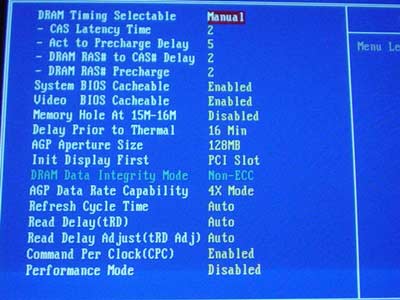
As shown in the picture above the IC7-G contains some excellent BIOS options for tweaking memory performance. Besides the standard memory timings you find on all Intel chipset-based motherboards, there is a "Performance Mode" option that allows speeds of "Fast", "Turbo", and "Ultra", options which are common among VIA chipset-based motherboards. Unfortunately these options are somewhat broken in the IC7-G BIOS, you can only use them if your memory timings are fairly relaxed. Aggressive timings with Performance Mode disabled yields more performance than relaxed timings with Performance Mode at "Turbo", so we suggest you shoot for the lowest memory timings possible when configuring your IC7-G. Still, it's nice to have options if your memory modules happen to be incapable of CAS 2-3-2-5 or lower.
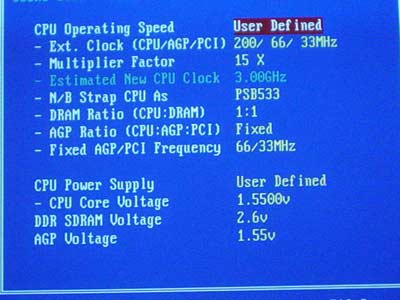
Another nice BIOS option comes in the form of an adjustable AGP/PCI option available as high as 96MHz/48MHz, which is more than enough for even the most hardcore overclockers. The IC7-G's Vcore range is easily the most intriguing feature of this BIOS. Adjustable up to a staggering 1.925V, this Vcore is especially appealing to overclockers, as too little a Vcore can definitely minimize your overclock despite the fact that most P4 overclockers can do just fine on default voltage (1.525V or 1.550V depending on your P4 processor). The IC7-G hardly undervolts so you will be able to reach approximately 1.90V in real world usage.
Among the more annoying aspects of the IC7-G are its horizontally placed Primary and Secondary IDE connectors. The fact that these connectors are placed horizontally is annoying enough, as you are forced to maneuver your IDE cables through other cables in your case. What's worse is that the Primary and Secondary IDE connectors are placed below the midsection of the motherboard, meaning the IDE cables that come bundled with the IC7-G may not reach the upper bays of certain ATX cases, especially the high-end ones that tend to be bigger than your standard computer case. This placement therefore forces you to install your optical drives on the lower bays, making the front of your case look fairly ridiculous, though I suppose that depends on how sensitive you are to aesthetics. Another negative aspect of the IC7-G is its very loud North Bridge fan. However, ABIT is currently in the middle of shipping new motherboards with a bigger, quieter North Bridge HSF so this will not be a concern for users purchasing in the not so distant future.
Originally published at https://www.anandtech.com/show/1114 (Wayback Machine).