
The Patriot Hellfire M.2 480GB Review: Phison NVMe Tested
Sequential Read Performance
The sequential read test requests 128kB blocks and tests queue depths ranging from 1 to 32. The queue depth is doubled every three minutes, for a total test duration of 18 minutes. The test spans the entire drive, and the drive is filled before the test begins. The primary score we report is an average of performances at queue depths 1, 2 and 4, as client usage typically consists mostly of low queue depth operations.
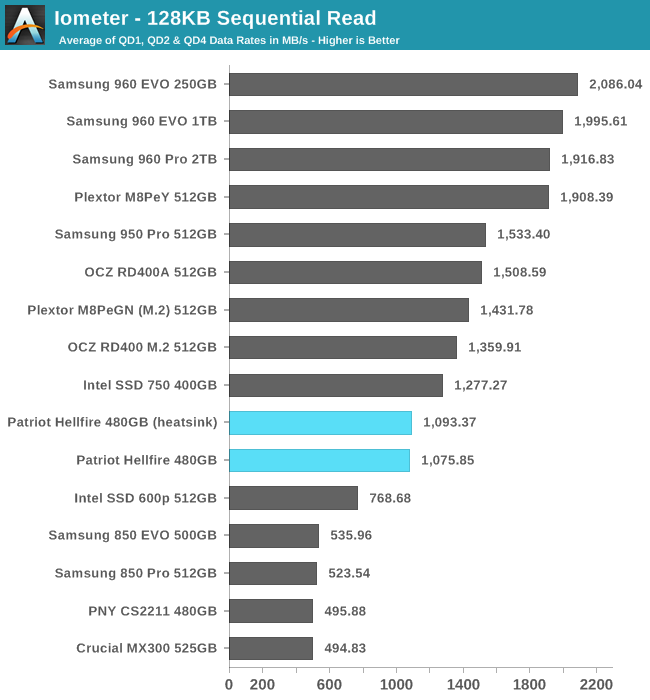
The sequential read speeds of the Patriot Hellfire are clearly slower than almost every other NVMe SSD, but it's still twice as fast as SATA SSDs. The TLC-based Intel SSD 600p falls in between the SATA SSDs and the Patriot Hellfire.
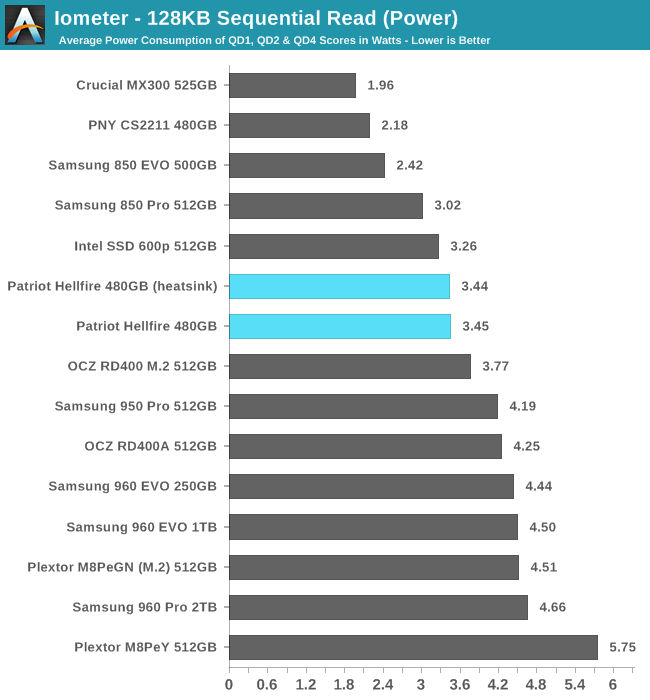
The Patriot Hellfire is also one of the lowest-power NVMe SSDs during sequential reads, so its efficiency isn't particularly poor for this test.
 |
|||||||||
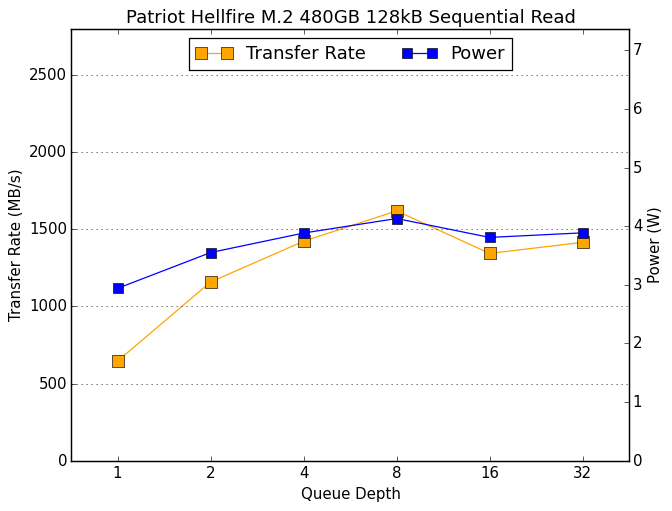
Near the end of the sequential read test the Patriot Hellfire's performance falters as it hits thermal limits, but the addition of a heatsink allows it to eventually catch up to the performance levels most other NVMe SSDs hit at much lower queue depths.
Sequential Write Performance
The sequential write test writes 128kB blocks and tests queue depths ranging from 1 to 32. The queue depth is doubled every three minutes, for a total test duration of 18 minutes. The test spans the entire drive, and the drive is filled before the test begins. The primary score we report is an average of performances at queue depths 1, 2 and 4, as client usage typically consists mostly of low queue depth operations.
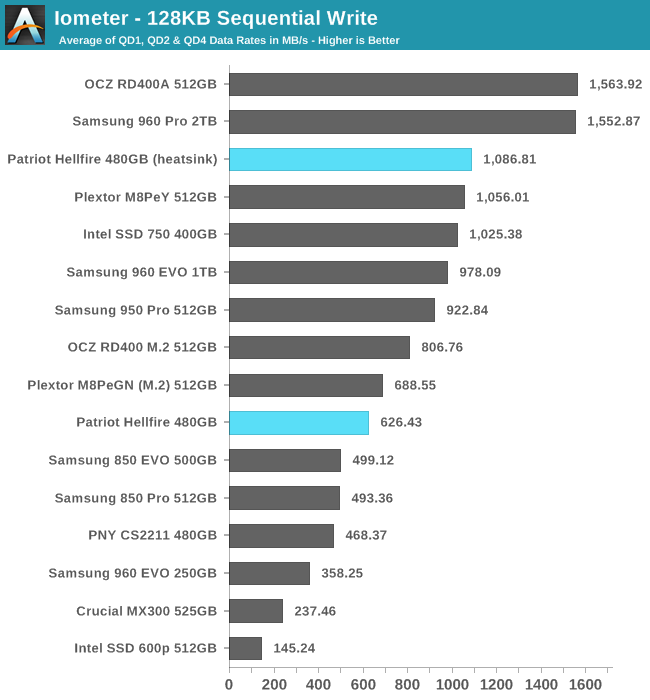
The heatsink makes a huge difference to the Patriot Hellfire's sustained sequential write performance, allowing it to pull slightly ahead of the Plextor M8PeY, but still leaving it far behind the OCZ RD400A.
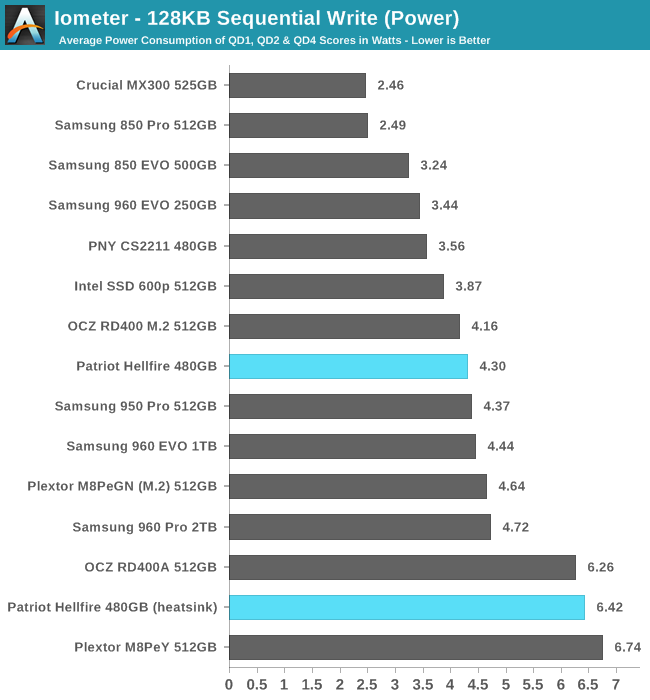
The Patriot Hellfire's efficiency is worse than its competition both with and without a heatsink attached. With a heatsink, it hits the highest power draw of any SSD in this bunch, after discounting the power used by the M8PeY's LEDs.
 |
|||||||||
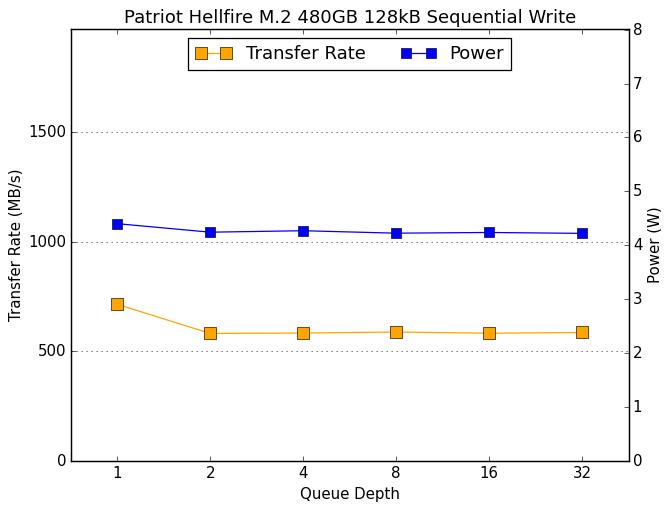
Without a heatsink, the Patriot Hellfire is thermally limited by the end of the QD1 test phase, and performance is completely flat for the rest of the test. With a heatsink, the performance scales substantially from QD1 to QD4 before reaching thermal limits.
Originally published at https://www.anandtech.com/show/11104/the-patriot-hellfire-m2-480gb-review-phison-nvme-tested (Wayback Machine).