
The Patriot Hellfire M.2 480GB Review: Phison NVMe Tested
AnandTech Storage Bench - The Destroyer
The Destroyer is an extremely long test replicating the access patterns of very IO-intensive desktop usage. A detailed breakdown can be found in this article. Like real-world usage and unlike our Iometer tests, the drives do get the occasional break that allows for some background garbage collection and flushing caches, but those idle times are limited to 25ms so that it doesn't take all week to run the test.
We quantify performance on this test by reporting the drive's average data throughput, a few data points about its latency, and the total energy used by the drive over the course of the test.
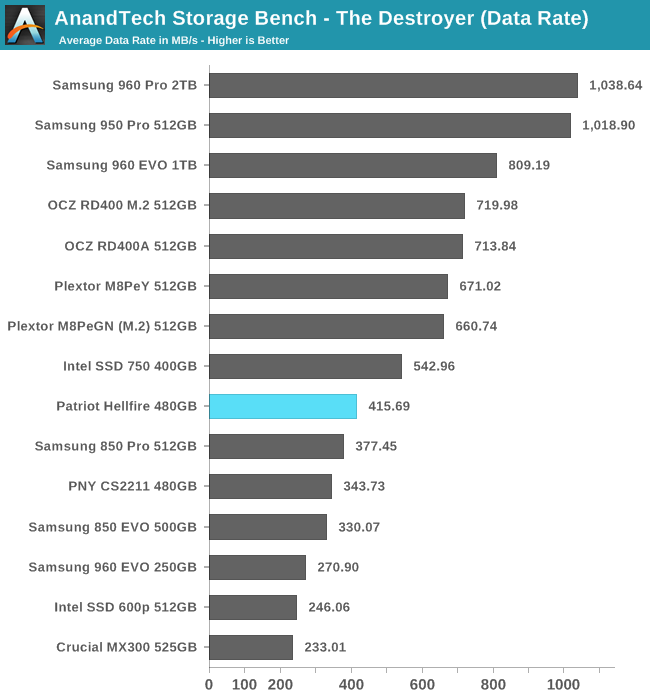
The Patriot Hellfire's average data rate on The Destroyer is slightly better than the fastest SATA SSD, but it is clearly the slowest MLC NVMe SSD in this bunch, and half the speed of Samsung's best.
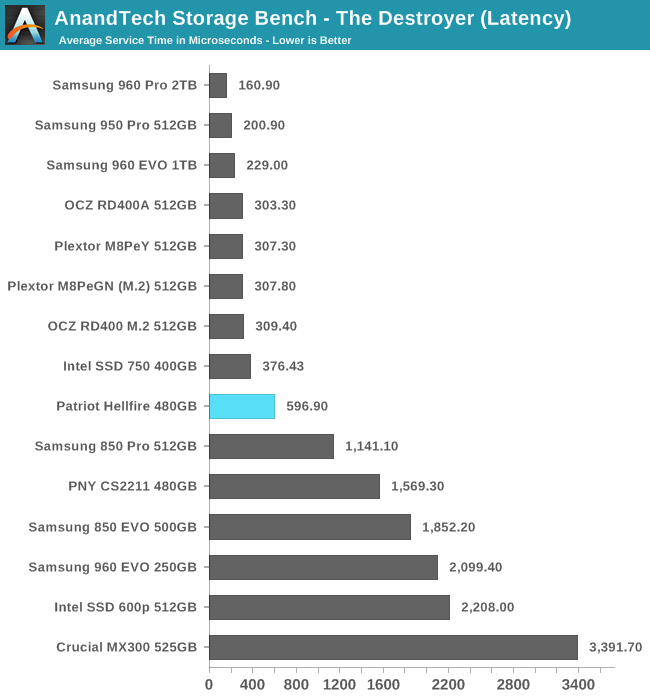
The Patriot Hellfire squanders some of the latency advantages of NVMe, with an average service time that is sitting in the middle of the gap between SATA SSDs and other MLC NVMe SSDs.
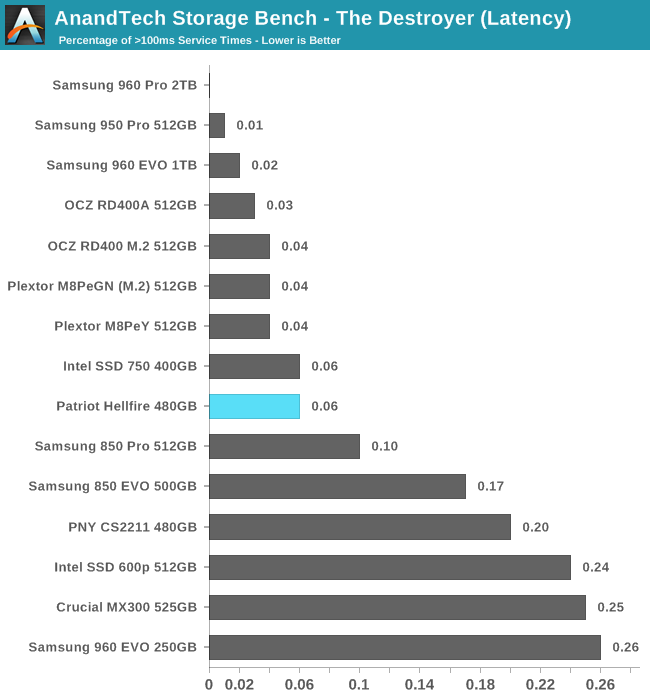
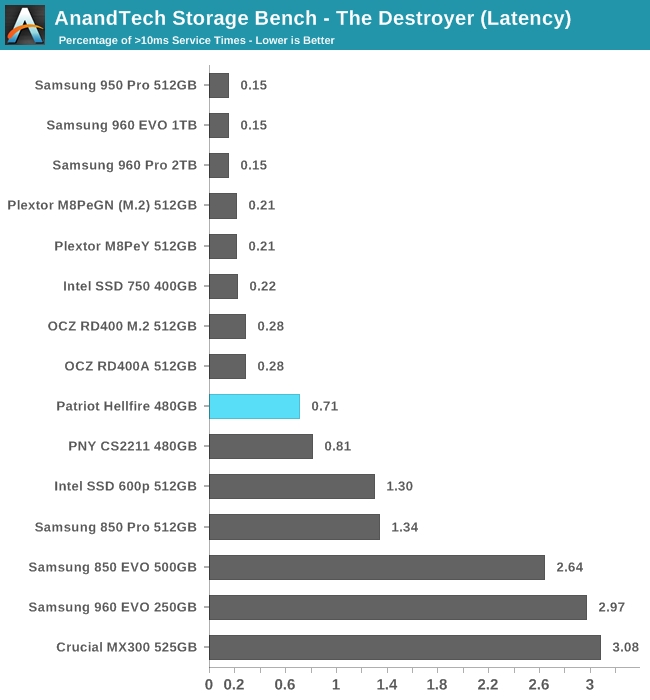
The Patriot Hellfire ties with the aging Intel SSD 750 for the number of latency outliers beyond 100ms, but at the 10ms level it is only barely ahead of the best SATA drive and has almost three times as many outliers as the next slowest NVMe SSD.
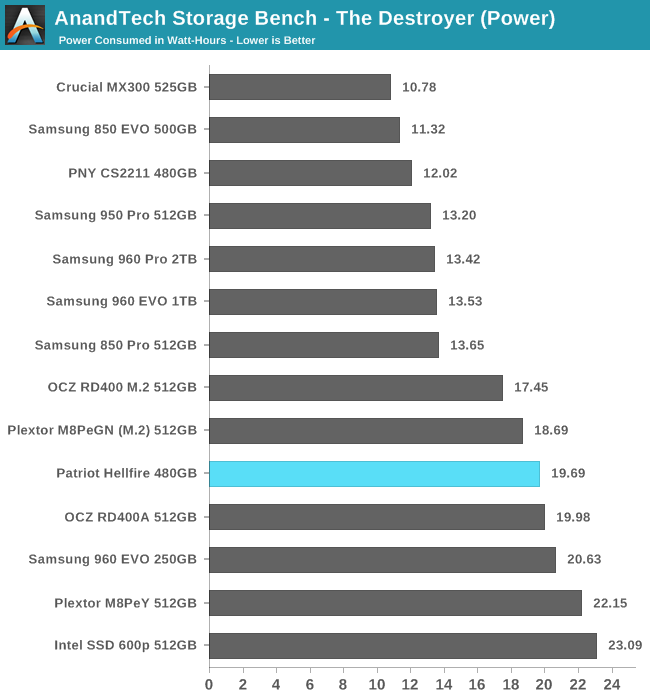
As with most NVMe SSDs, the Patriot Hellfire burns substantially more energy over the course of The Destroyer than any good SATA SSD. Samsung remains the only company to deliver a PCIe SSD that is on par with SATA SSDs for this power usage metric.
Originally published at https://www.anandtech.com/show/11104/the-patriot-hellfire-m2-480gb-review-phison-nvme-tested (Wayback Machine).