
Intel 865 (Springdale) Chipset: Mainstream Dual DDR
- Posted in
- CPUs
Finally, we have the 865G, which is the 865PE but with Intel's integrated graphics core - selling for $41. Disappointingly enough the 865G uses the same graphics core as the 845G, which as we've seen in the past can hardly be considered to be a 3D accelerator. For basic 2D application support, Intel's integrated graphics works fine (although there is a noticeable performance hit with integrated graphics enabled); if Intel wants their graphics to be taken seriously when Microsoft's 3D UI debuts in 2005 with Longhorn then we'll have to see a dramatic change in how seriously they take integrated graphics.
Intel's 865G
Intel will be updating their integrated graphics core in Q2 2004 with their Grantsdale-G chipset, which we'll talk about later.
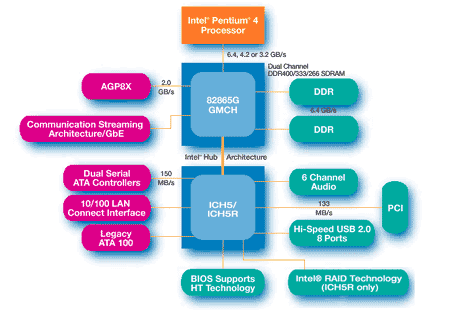
As you can see, the only thing the 865 family is lacking is Intel's Performance Acceleration Technology (PAT) that is supposed to allow the 875P to offer higher performance. The fact that all 865 chipsets have support for CSA and that they are all dual channel DDR solutions means that they will all be much more competitive with the high-end than the 845 series was. Intel did also strip the 865 family of ECC memory support in an effort to make the 875P more of a target for entry-level workstations, but for most users this won't matter.
We have already shown the performance advantages you can expect to see from the 800MHz FSB, Dual DDR400 as well as CSA so be sure to read our 875P review in order to see the performance results as well as understand how each one of those technologies works.
One word of warning about 865 (and 875P) motherboards and CSA support; just because a motherboard features gigabit Ethernet doesn't mean that it's connected over the CSA bus. Some motherboard manufacturers are shipping boards with gigabit Ethernet over PCI instead of over CSA, which severely limits the performance potential of gigabit Ethernet. Remember that with CSA, all transfers over a gigabit Ethernet network essentially occur at hard drive speed (unless you've got an array that can transfer at over ~100MB/s) whereas with 100Mbit Ethernet you're limited to a realistic transfer rate of around 10MB/s. Having just upgraded the main AnandTech Lab to gigabit Ethernet, we can attest to the performance improvement courtesy of the CSA bus.
Originally published at https://www.anandtech.com/show/1106 (Wayback Machine).