
The Samsung 960 EVO (1TB) Review
Mixed Random Read/Write Performance
The mixed random I/O benchmark starts with a pure read test and gradually increases the proportion of writes, finishing with pure writes. The queue depth is 3 for the entire test and each subtest lasts for 3 minutes, for a total test duration of 18 minutes. As with the pure random write test, this test is restricted to a 16GB span of the drive, which is empty save for the 16GB test file.
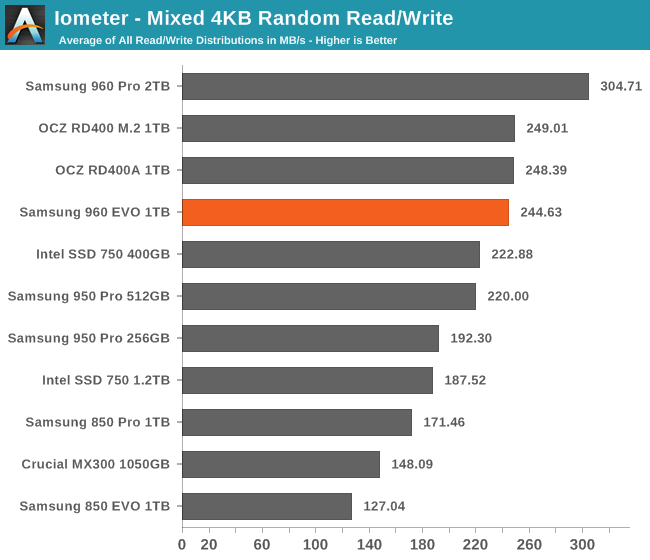
The 960 EVO is essentially tied for second place with the OCZ RD400 and significantly behind the 960 Pro in overall performance on mixed random I/O.
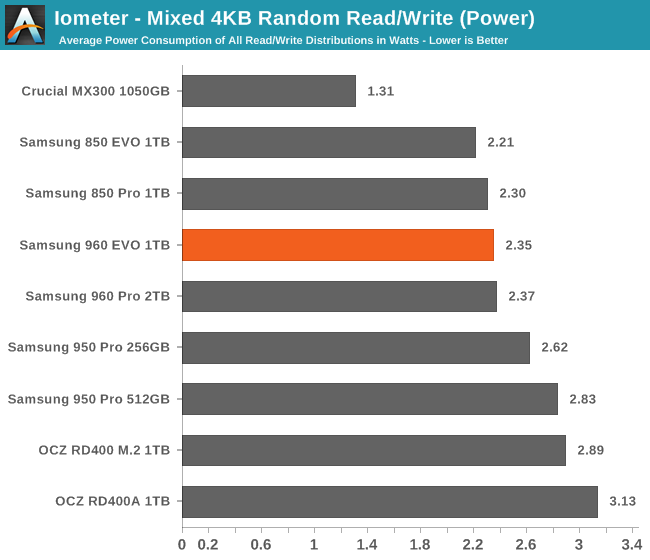
The 960 EVO's power efficiency on this test is not great, but it is a big improvement over last year's 950 Pro.
 |
|||||||||
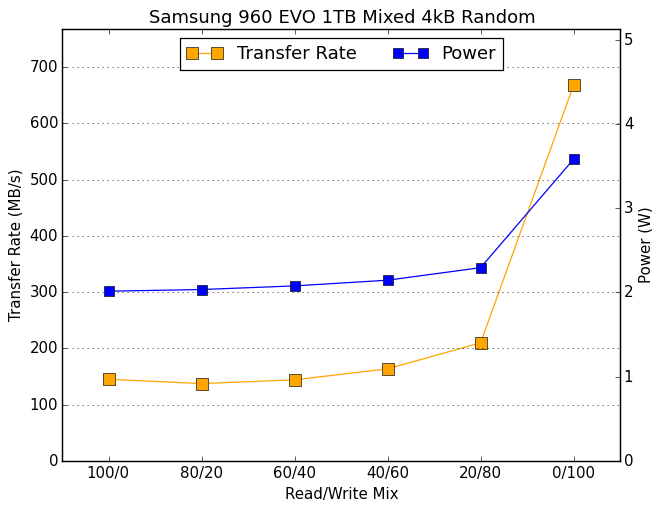
The 960 EVO's high performance score comes primarily from its great performance in the pure write final phase of the test. Throughout the rest of the test, the 960 EVO is not as fast as the 950 Pro.
Mixed Sequential Read/Write Performance
The mixed sequential access test covers the entire span of the drive and uses a queue depth of one. It starts with a pure read test and gradually increases the proportion of writes, finishing with pure writes. Each subtest lasts for 3 minutes, for a total test duration of 18 minutes. The drive is filled before the test starts.
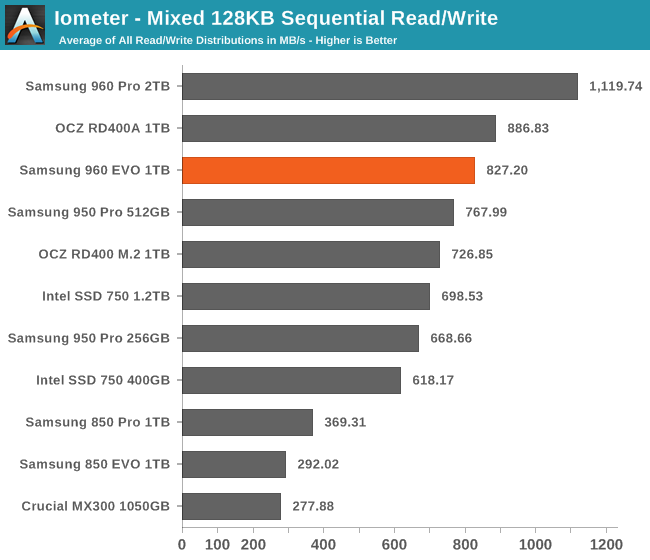
The 960 EVO's mixed sequential I/O performance is the second-fastest among M.2 SSDs and third place overall. Performance is modestly improved over the 950 Pro.
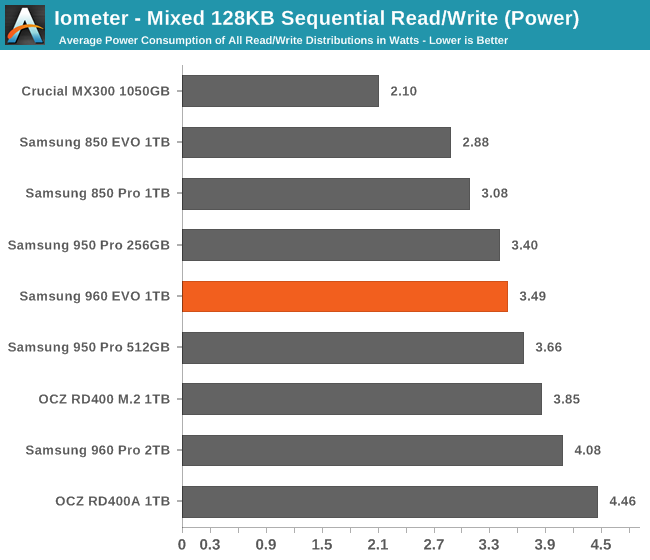
The 960 EVO's power efficiency is better than most PCIe SSDs, but still well behind the 960 Pro.
 |
|||||||||
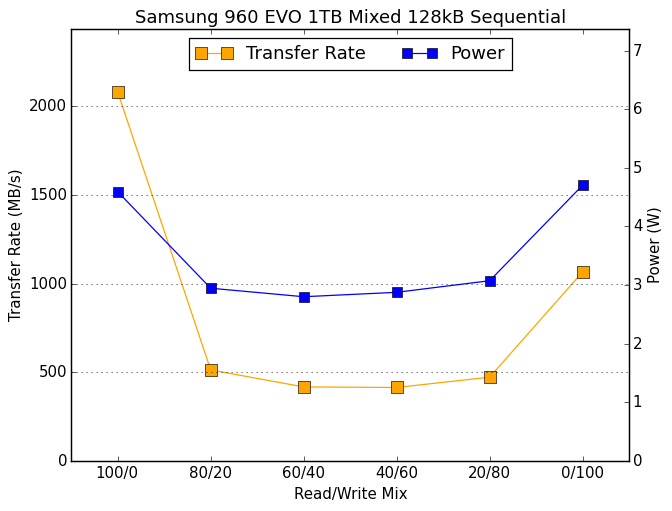
The 960 EVO's performance in the pure read first phase of the test is great, but its performance with an 80/20 mix is much worse than the 950 Pro or OCZ RD400. The worst-case performance is also not as good as the RD400 or 960 Pro.
Originally published at https://www.anandtech.com/show/10833/the-samsung-960-evo-1tb-review (Wayback Machine).