
ADATA SE730, SV620 and SC660 External SSDs Review
Miscellaneous Aspects and Concluding Remarks
External flash-based devices that support UASP fully can translate the SCSI UNMAP command to TRIM commands for the controller connected to the internal SSD. We already saw that the SC660 and SV620 do not support the NCQ feature of UASP. But, it is still worthwhile to check if the TRIM command is passed through the bridge chip. We already know from our evaluation of the Satechi USB 3.1 Gen 2 Type-C enclosure that the VIA Labs VL716 is capable of passing TRIM commands downstream. We expected no trouble with the SE730 on this front, but, it was worth testing out.
Checking for TRIM support has been a bit tricky so far. CyberShadow's trimcheck is a quick tool to get the status of TRIM support. However, it presents a couple of challenges: it sometimes returns INDETERMINATE after processing, and, in case TRIM comes back as NOT WORKING or not kicked in yet, it is not clear whether the blame lies with the OS / file system or the storage controller / bridge chip or the SSD itself. In order to get a clear idea, our TRIM check routine adopts the following strategy:
- Format the SSD in NTFS
- Load the trimcheck program into it and execute
- Use the PowerShell command Optimize-Volume -DriveLetter Z -ReTrim -Verbose (assuming that the drive connected to the storage bridge is mounted with the drive letter Z)
- Re-execute trimcheck to determine status report
Conclusions can be made based on the results from the last two steps.


All the three external SSDs have no problems in supporting TRIM commands from the OS.
ADATA has been in the SSD market for quite some time, and it is good to see them come out with options for the external high-performance USB flash storage devices market. The SE730 is a very compelling product with the right mixture of features for its price. It is both dust and water-proof, uses MLC flash, has consistent performance and comes with TRIM support. The only other sturdy external SSD that we have evaluated before - the SanDisk Extreme 510 - came with an IP55 rating (compared to the IP68 of the ADATA SE730), and had trouble with thermal throttling under sustained traffic. The ADATA SE730 has no such issues. We have no reservations in recommending the SE730 to consumers looking for a compact, sturdy and durable external SSD.
Things are a bit different on the SV620 / SC660 front. The SLC caching scheme may work great for the internal drive usage patterns of the average consumer, but, it is not a good for write-intensive direct-attached storage workloads. The two external SSDs are meant to be affordable options, and as long as the end user understands the constraints involved (suitability for read-intensive usage patterns), they could turn out to be good value for the money. The performance consistency issue for write workloads prevents us from giving an unqualified recommendation for the SV620 and SC660.
The final aspect being considered today is the pricing. We find that the SE730 carries a bit of a premium (almost US $0.50 per GB), but the SV620 480GB version is almost as cheap as a thumb drive in terms of cost per GB. The SE730 250GB has a street price of $120, while the SV620 480GB version comes in at $135. The SC660 240GB version reviewed in this article has a street price of $90.
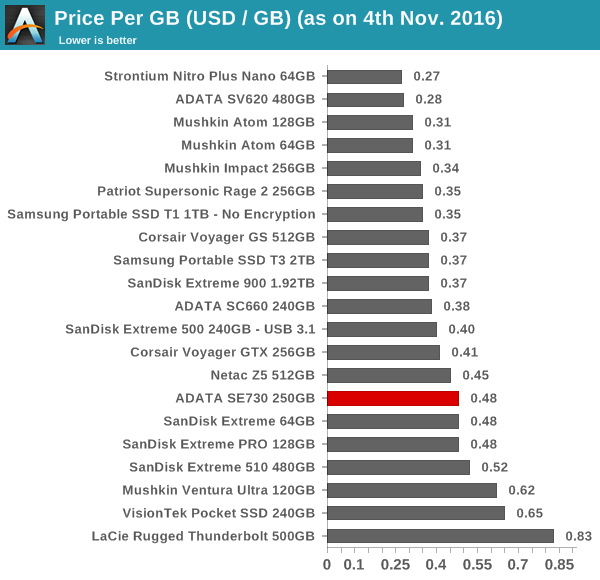
All said, the three external SSDs from ADATA form an interesting trio and target different price points and usage scenarios. We have no qualms in recommending the SE730, while the SC660 and SV620 are to be considered only after a careful understanding of the trade-offs involved.
Originally published at https://www.anandtech.com/show/10812/adata-se730-sv620-and-sc660-external-ssds-review (Wayback Machine).