
The Toshiba OCZ VX500 (256GB, 512GB, 1024GB) SSD Review
ATTO
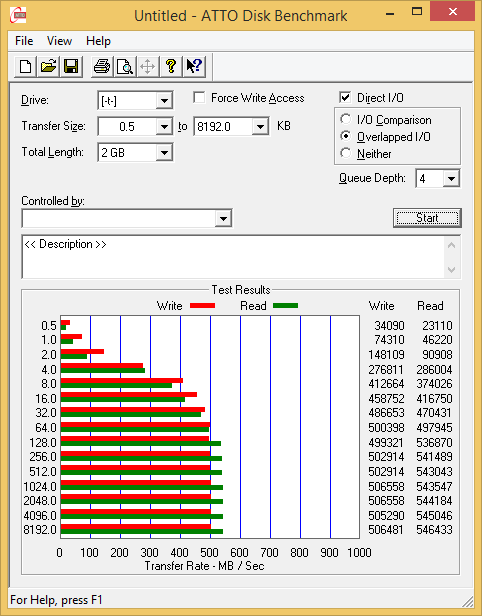
ATTO's Disk Benchmark is a quick and easy freeware tool to measure drive performance across various transfer sizes.
 |
|||||||||
At small transfer sizes, the OCZ VX500 has better read speed but worse write speed than the Vector 180. Unlike the Vector 180, the VX500 maintains steady performance through the second half of the test with solid read and write speeds.
AS-SSD
AS-SSD is another quick and free benchmark tool. It uses incompressible data for all of its tests, making it an easy way to keep an eye on which drives are relying on transparent data compression. The short duration of the test makes it a decent indicator of peak drive performance.
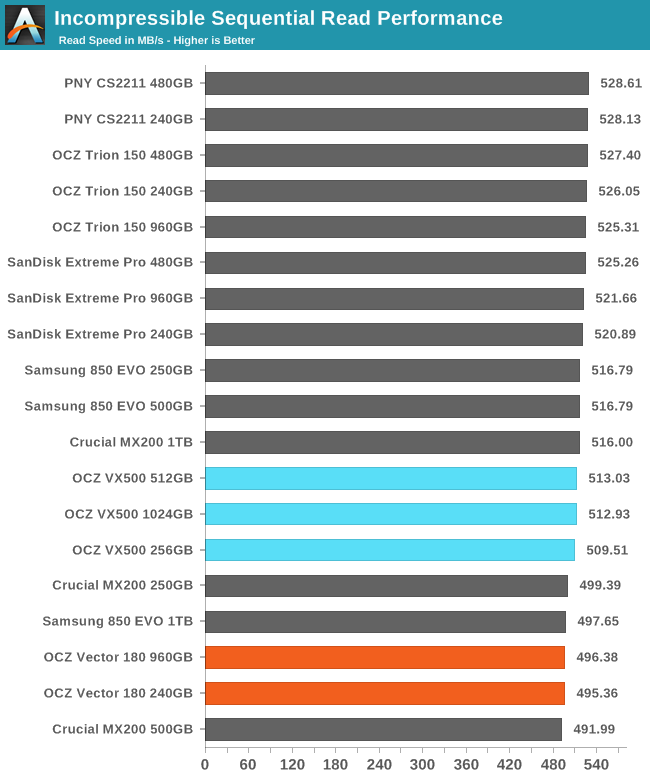
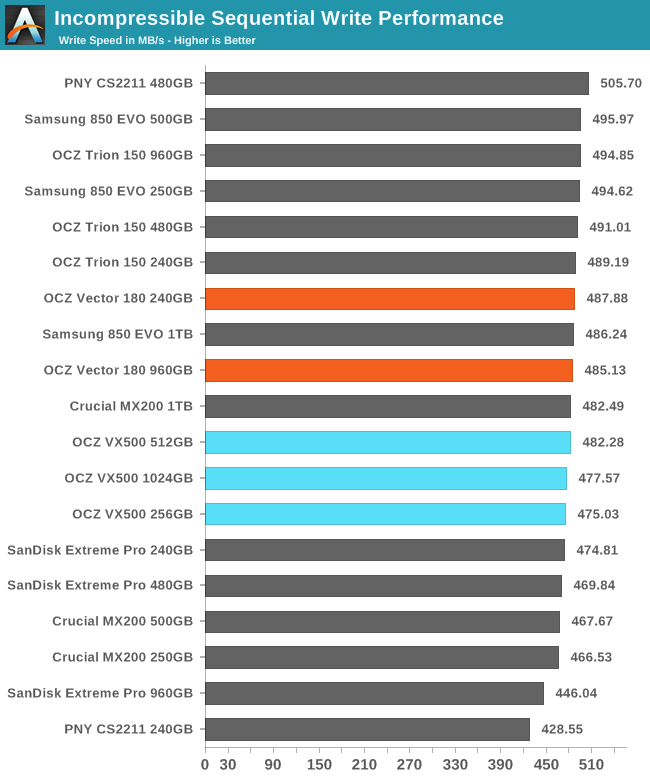
Peak read speeds for the VX500 are good and a slight but ultimately meaningless improvement over the Vector 180. Peak sequential write speeds are confirmed to be fine despite the poor showing on the more intense IOmeter test.
Idle Power Consumption
Since the ATSB tests based on real-world usage cut idle times short to 25ms, their power consumption scores paint an inaccurate picture of the relative suitability of drives for mobile use. During real-world client use, a solid state drive will spend far more time idle than actively processing commands. Our testbed doesn't support the deepest DevSlp power saving mode that SATA drives can implement, but we can measure the power usage in the intermediate slumber state where both the host and device ends of the SATA link enter a low-power state and the drive is free to engage its internal power savings measures.
We also report the drive's idle power consumption while the SATA link is active and not in any power saving state. Drives are required to be able to wake from the slumber state in under 10 milliseconds, but that still leaves plenty of room for them to add latency to a burst of I/O. Because of this, many desktops default to either not using SATA Aggressive Link Power Management (ALPM) at all or to only enable it partially without making use of the device-initiated power management (DIPM) capability. Additionally, SATA Hot-Swap is incompatible with the use of DIPM, so our SSD testbed usually has DIPM turned off during performance testing.
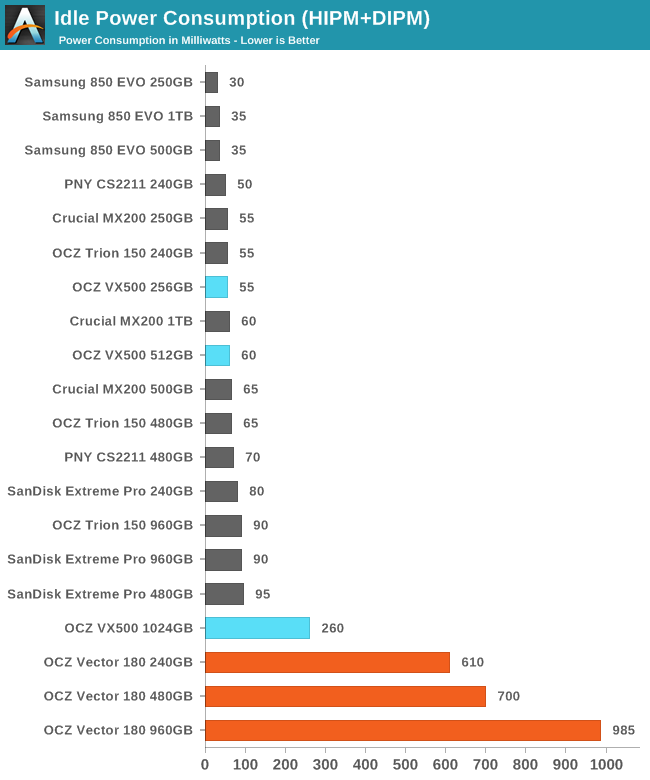
With no SATA ALPM support from the Barefoot 3 controller, the Vector 180 distorts the scale of the slumber power graph. The smaller capacities of the VX500 are fine, but the 1TB is using an extra 200mW, most likely because the external DRAM interface is remaining active.
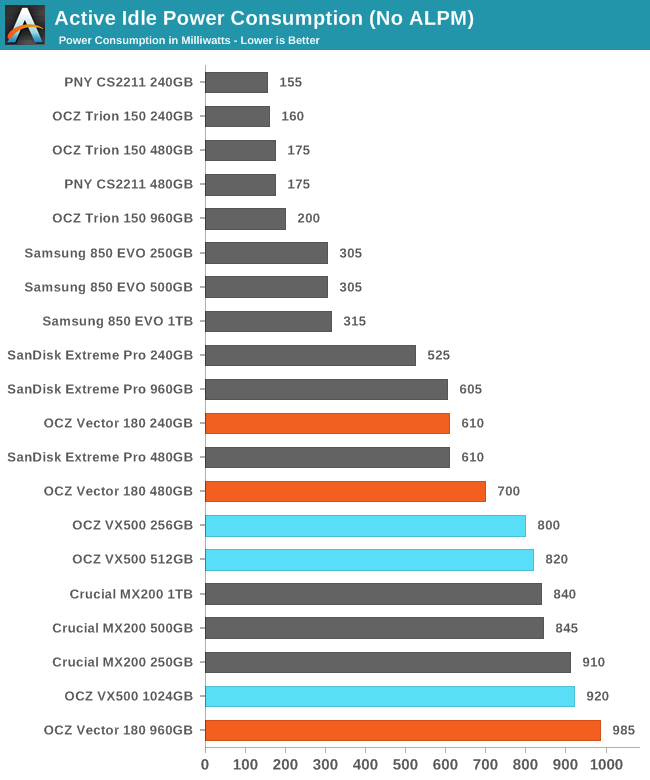
Active idle power consumption is not great and only the 1TB manages to be an improvement over the Vector 180, but most mobile systems make proper use of the slumber state and are thus unaffected by this.
Originally published at https://www.anandtech.com/show/10674/the-toshiba-ocz-vx500-ssd-review (Wayback Machine).