
Zotac ZBOX MAGNUS EN980 SFF PC Review - An Innovative VR-Ready Gaming Powerhouse
HTPC Credentials
The ZBOX MAGNUS EN980 is remarkably silent consiering the size of the unit and its gaming capabilities. Watercooling enables the fans to operate at very low speeds compared to the regular heat sink and blower combinations used in other mini-PCs. Obviously, the unit is not for the discerning HTPC enthusiast who is better off with a passively cooled system. Its acoustic profile doesn't do any disservice to the EN980's chances of being used as a gaming HTPC.
Refresh Rate Accurancy
Starting with Haswell, Intel, AMD and NVIDIA have been on par with respect to display refresh rate accuracy. The most important refresh rate for videophiles is obviously 23.976 Hz (the 23 Hz setting). As we have come to expect from NVIDIA, the default refresh rate accuracy is not that great, though they do allow fine-tuning of the refresh rate unlike other GPU vendors.

The gallery below presents some of the other refresh rates that we tested out. The first statistic in madVR's OSD indicates the display refresh rate.


Network Streaming Efficiency
Evaluation of OTT playback efficiency was done by playing back our standard YouTube test stream and five minutes from our standard Netflix test title. Using HTML5, the YouTube stream plays back a 1080p H.264 encoding. Since YouTube now defaults to HTML5 for video playback, we have stopped evaluating Adobe Flash acceleration. Note that only NVIDIA exposes GPU and VPU loads separately. Both Intel and AMD bundle the decoder load along with the GPU load. The following two graphs show the power consumption at the wall for playback of the HTML5 stream in Mozilla Firefox (v 47.0.1). The power numbers are nothing spectacular, and come well behind other mini-PCs which have U-series CPUs or don't carry the burden of a discrete GPU.
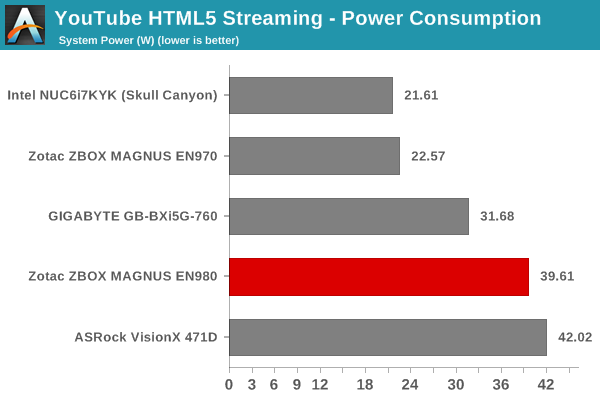
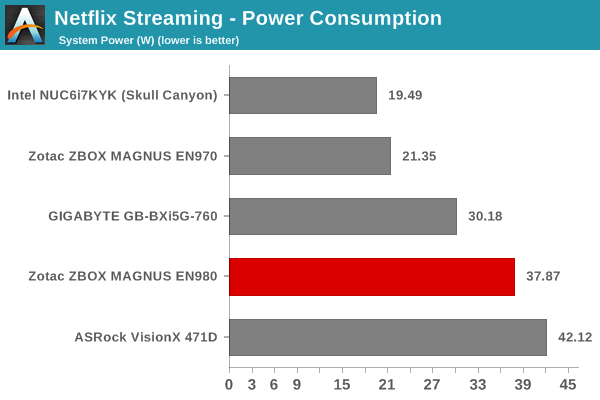
GPU load and VPU load were around 14% and 13% for the YouTube HTML5 stream.GPU load in the steady state for the Netflix streaming case was 5% and the VPU load was 16.5%.
Netflix streaming evaluation was done using the Windows 10 Netflix app. Manual stream selection is available (Ctrl-Alt-Shift-S) and debug information / statistics can also be viewed (Ctrl-Alt-Shift-D). Statistics collected for the YouTube streaming experiment were also collected here.
Decoding and Rendering Benchmarks
In order to evaluate local file playback, we concentrate on Kodi (for the casual user) and madVR (for the HTPC enthusiast). Under madVR, we decided to test out a 'stress' configuration with the following settings changed compared to the default configuration:
- Fullscreen rendering configured in window mode
- Processing
- Deinterlacing activated when in doubt
- Banding artifacts reduced with high debanding strength and high strength during fade in/out
- Ringing artifacts reduced
- Scaling
- Chroma upscale : NNEDI3 with 16 neurons
- Image downscale: Jinc, with anti-ringing filter activated in relaxed mode, and scaling in linear light
- Image upscale : Jinc, with anti-ringing filter activated, and scaling in sigmoidal light
In the madVR case, the LAV Filters (configured to decode with dxva2n codec) bundled with MPC-HC v1.7.7 was used.
In our earlier reviews, we focused on presenting the GPU loading and power consumption at the wall in a table (with problematic streams in bold). Starting with the Broadwell NUC review, we decided to represent the GPU load and power consumption in a graph with dual Y-axes. Nine different test streams of 90 seconds each were played back with a gap of 30 seconds between each of them. The characteristics of each stream are annotated at the bottom of the graph. Note that the GPU usage is graphed in red and needs to be considered against the left axis, while the at-wall power consumption is graphed in green and needs to be considered against the right axis.

Frame drops are evident whenever the GPU load consistently stays above the 85 - 90% mark. The only issue is the 4Kp30 stream with madVR stress configuration enabled. It appears that even the GTX 980 can be made to struggle with complicated madVR settings.

Moving on to the codec support, the GTX 980 is a known quantity with respect to the scope of supported hardware accelerated codecs. There is no VP9 or HEVC Main10 hardware-accelerated decode support. DXVA Checker serves as a confirmation.

Originally published at https://www.anandtech.com/show/10595/zotac-zbox-magnus-en980-sff-pc-review-an-innovative-vrready-gaming-powerhouse (Wayback Machine).