
ASRock Beebox-S 6200U Review - An Alternative to the Skylake NUC
Miscellaneous Aspects and Concluding Remarks
The ASRock Beebox-S 6200U provided us with the opportunity to evaluate a different take on the Skylake-U platform. Intel set the bar with the NUC6i5SYK, and ASRock has managed to provide a unique set of allied features at a different price point.
Our main feedback to ASRock (in terms of scope for improvement) is about the chassis design. The size and volume are between that of the Intel NUC6i5SYK (which doesn't have support for a 2.5" drive) and the Skylake BRIX-H (which supports a 2.5" drive).

Relative Sizes of Skylake UCFF PCs - GIGABYTE GB-BSi7HAL-6500 (top left), Intel NUC6i5SYK (top right) and the ASRock Beebox-S 6200U (bottom)
The layout is very cramped, making even SODIMM installation a bit of a challenge. Installing a 2.5" drive is even more of a pain with the necessity to route the SATA cable around the SODIMM. While the initial setup issue is a one-tie hassle, the effect of the SODIMM heating up on the SATA cable is a bit of a worry. It is best to use a M.2 2260 SSD in the unit, but, 2280 SSDs are more common. Installing such a SSD is possible, but, requires a separate plastic tab. The M.2 SSD also has no thermal protection support from the chassis design.
On the positive side, we can see that the M.2 SSD slot also gets a PCIe 3.0 x4 uplink to the PCH in addition to SATA support The OPI (on-package interface) link rate between the CPU and PCH is also configured for the best possible performance (effective bandwidth of PCIe 3.0 x4).
The thermal solution for the processor turns out OK because it is configured with a lower TDP compared to the ones in other similar UCFF PCs (say, the Core i5-6260U in the Intel NUC6i5SYK). The Core i5-6260U is supposed to have better performance than the Core i5-6200U for a given TDP level, but the observed differences between the NUC6i5SYK and the Beebox-S 6200U are too much to explain away with just the clock rates and the cache sizes. This again comes back to the chassis design. I am sure consumers wouldn't mind a slightly larger chassis if the processor's TDP can be configured upwards for better performance while maintaining a good thermal profile.
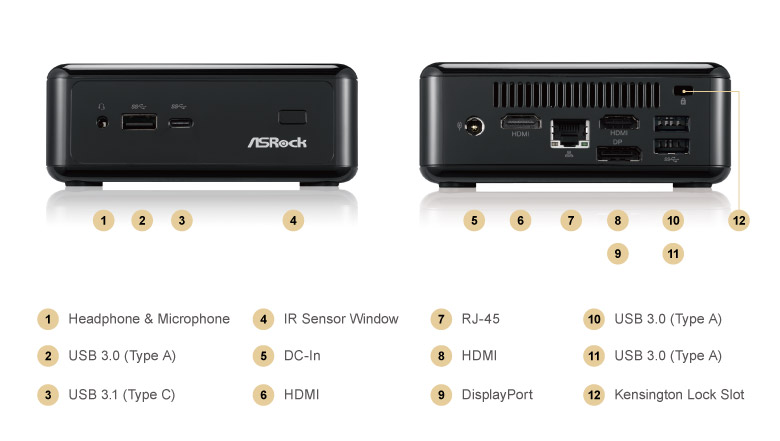
Coming back to the positives, we find that the Beebox-S 6200U has a USB 3.1 Gen 2 Type-C port (enabled by the ASMedia ASM1142 bridge chip) - this is not present in the Intel NUC6i5SYK. However, the latter has a SDXC 3.0 slot that doesn't exist in the Beebox-S. A MegaChips LSPCon / DP to HDMI 2.0 converter is also present in the Beebox-S, but not in the NUC. The NUC, however, pulls things back with a 2x2 802.11ac solution in the Intel AC8260 compared to the 1x1 802.11ac solution (Intel AC3165) used in the Beebox-S. Both of the mini-PCs have an Intel I219V GbE port - that is a plus point compared to some of the other mini-PCs that use Realtek controllers.
The above aspects of comparison between the Beebox-S 6200U and the NUC6i5SYK doesn't show a clear winner, though the Intel NUC might be preferable for the average consumer. However, ASRock wins out on the all-important pricing aspect. While the Intel NUC6k5SYK retails for $377, the Beebox-S 6200U is only $320 (both barebones).
Coming to the business end of the review, it is clear that ASRock can do plenty to improve the current hardware design. These improvements can make the unit operate in a more reliable manner in the long run, while also providing a good user experience during the setup process. However, that doesn't take away the fact that the ASRock Beebox-S provides a good-enough experience at a lower price point compared to the NUC6i5SYK. It is always good to have multiple options in the market for a Skylake-U mini-PC, and ASRock has targeted the price-conscious buyer with a good balance of features / performance and cost.
Originally published at https://www.anandtech.com/show/10547/asrock-beeboxs-6200u-review-an-alternative-to-the-skylake-nuc (Wayback Machine).