
ASRock Beebox-S 6200U Review - An Alternative to the Skylake NUC
Networking and Storage Performance
Networking and storage are two major aspects which influence our experience with any computing system. This section presents results from our evaluation of these aspects in the ASRock Beebox-S 6200U.
One of the interesting aspects of the Skylake-U platform is the bandwidth available for communication between the CPU and the PCH inside the Skylake-U package. By default, Intel ships them optimized for low power consumption (effectvely four lanes of PCIe 2.0 bandwidth). However, its customers can optimize for higher performance (effectively four lanes of PCIe 3.0 bandwidth) depending on the end system in which the Skylake-U SiP gets deployed. We covered this in detail in our article on choosing the right M.2 SSD for the NUC6i5SYK.
ASRock has configured the Core i5-6200U for hgher performance in the Beebox-S 6200U. Our quick check for this involved running the CrystalDiskMark benchmark on the Samsung SSD 950 PRO after installing it in the Beebox-S 6200U. We can see that the M.2 PCIe SSD is able to meet its full claimed performance numbers (possible only with a PCIe 3.0 x4 link).

In order to further evaluate storage performance, one option would be repetition of our strenuous SSD review tests on the drive(s) in the PC. Fortunately, to avoid that overkill, PCMark 8 has a storage bench where certain common workloads such as loading games and document processing are replayed on the target drive. Results are presented in two forms, one being a benchmark number and the other, a bandwidth figure. We ran the PCMark 8 storage bench on selected PCs and the results are presented below.
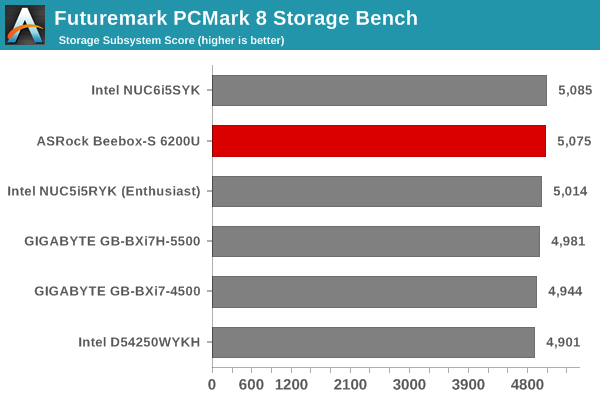
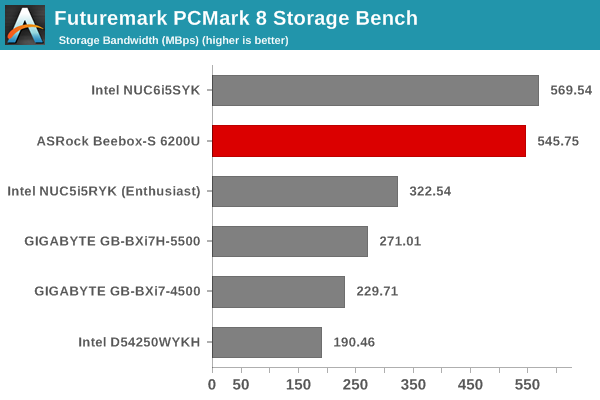
Thanks to ASRock's attention to the OPI link rate in the Core i5-6200U, the storage benchmarks show the Beebox-S 6200U come out in the top half of the list.
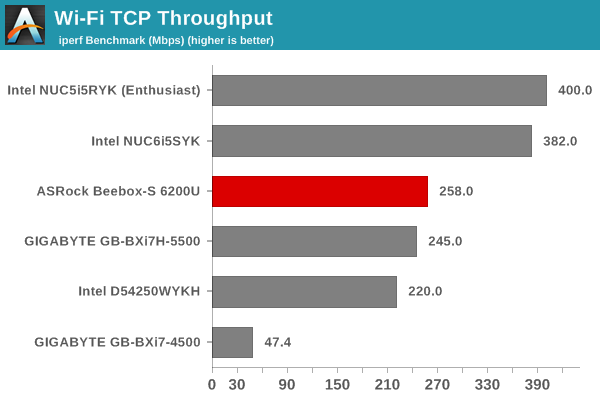
On the networking side, we restricted ourselves to the evaluation of the WLAN component. Our standard test router is the Netgear R7000 Nighthawk configured with both 2.4 GHz and 5 GHz networks. The router is placed approximately 20 ft. away, separated by a drywall (as in a typical US building). A wired client is connected to the R7000 and serves as one endpoint for iperf evaluation. The PC under test is made to connect to either the 5 GHz (preferred) or 2.4 GHz SSID and iperf tests are conducted for both TCP and UDP transfers. It is ensured that the PC under test is the only wireless client for the Netgear R7000. We evaluate total throughput for up to 32 simultaneous TCP connections using iperf and present the highest number in the graph below.
In the UDP case, we try to transfer data at the highest rate possible for which we get less than 1% packet loss.
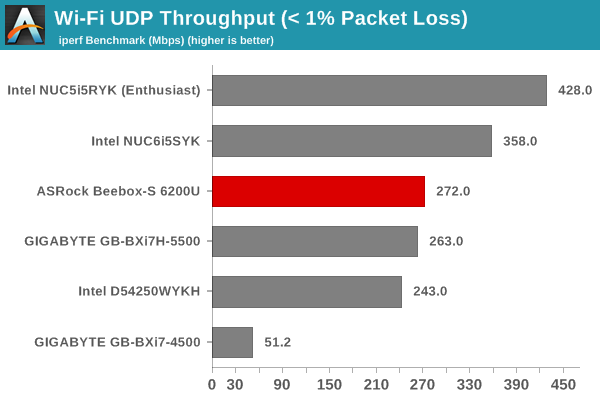
The Beebox-S has very good antenna placement, and make it come out on top when other PCs that have 1x1 configurations are considered. However, mini-PCs that have 2x2 802.11ac WLAN chipsets obviously perform better than the Beebox-S 6200U.
Originally published at https://www.anandtech.com/show/10547/asrock-beeboxs-6200u-review-an-alternative-to-the-skylake-nuc (Wayback Machine).