
The Skylake Core i3 (51W) CPU Review: i3-6320, i3-6300 and i3-6100 Tested
Office Performance
All of our benchmark results can also be found in our benchmark engine, Bench.
Agisoft Photoscan – 2D to 3D Image Manipulation: link
Agisoft Photoscan creates 3D models from 2D images, a process which is very computationally expensive. The algorithm is split into four distinct phases, and different phases of the model reconstruction require either fast memory, fast IPC, more cores, or even OpenCL compute devices to hand. Agisoft supplied us with a special version of the software to script the process, where we take 50 images of a stately home and convert it into a medium quality model. This benchmark typically takes around 15-20 minutes on a high end PC on the CPU alone, with GPUs reducing the time.
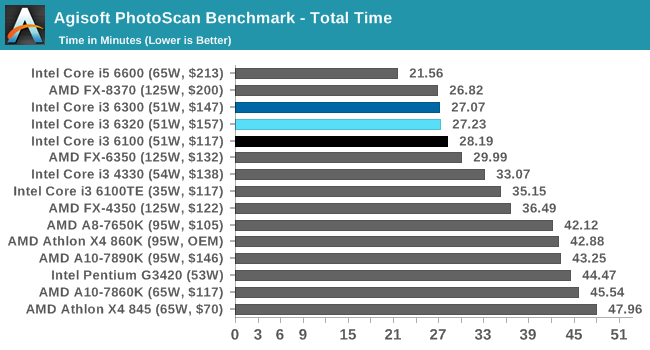
The different stages of Photoscan have different preferences for frequency and threads, but all the results are in Bench. In this case having threads matters, with the old 8-thread FX CPU barely getting ahead of the Core i3 parts. The i5 takes the lead, showing that having physical cores helps with cache management. This is further reinforced by our results staircase, which put the i3-6320 and i3-6300 at roughly equal timings but the i3-6100 almost 4% behind.
Cinebench R15
Cinebench is a benchmark based around Cinema 4D, and is fairly well known among enthusiasts for stressing the CPU for a provided workload. Results are given as a score, where higher is better.
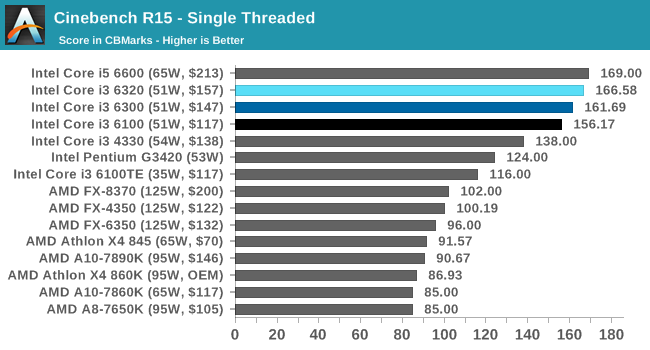
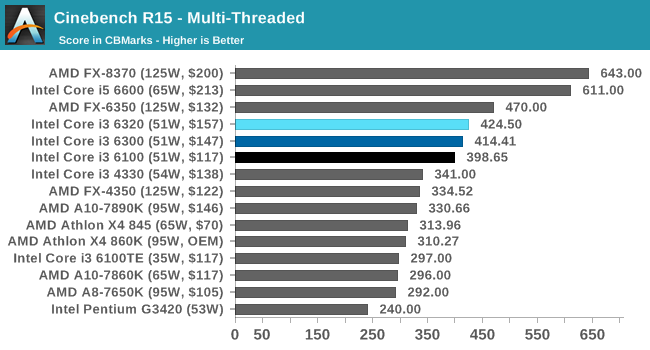
Cinebench eats threads, high IPC and high frequency for breakfast. In the single thread test, the high Intel IPC shines through, and our i3 parts sit in unison with AMD behind by up to 40%. In multithreaded land, the 6/8 thread FX processors go ahead of the i3s as expected, and our staircase slightly deviates for the i3-6100 showing that L3 cache creep is slowly coming in.
HandBrake v0.9.9: link
For HandBrake, we take two videos (a 2h20 640x266 DVD rip and a 10min double UHD 3840x4320 animation short) and convert them to x264 format in an MP4 container. Results are given in terms of the frames per second processed, and HandBrake uses as many threads as possible.
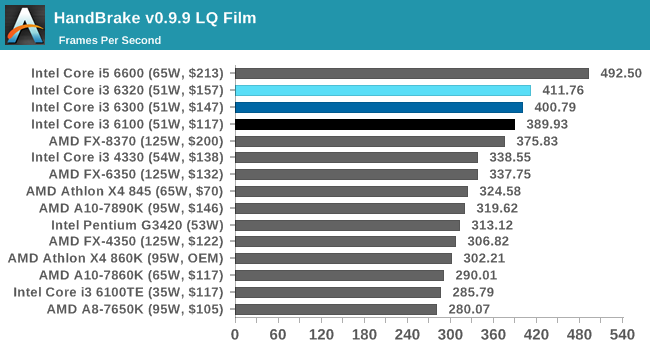
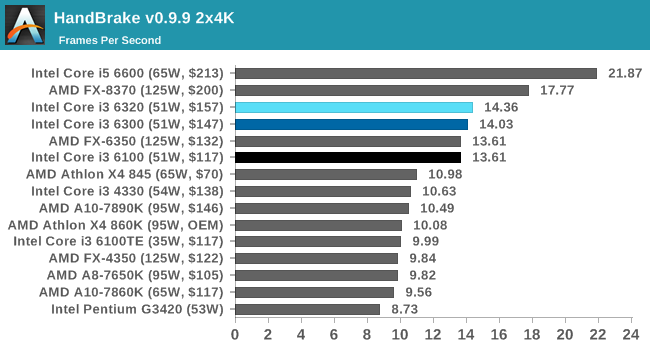
The high IPC of the Skylake parts makes a difference for the smaller frame conversion, while threads come into play for the larger resolution frames. In both cases, the regular staircase shows a lack of issues with the L3 cache differences, but it is interesting to see the X4 845 hot on the heels for the high resolution frames despite its cache arrangement. The FX-6350 sits on par with the i3-6100, showcasing the difference between a six-thread much older processor and a four thread latest process part.
Hybrid x265
Hybrid is a new benchmark, where we take a 4K 1500 frame video and convert it into an x265 format without audio. Results are given in frames per second.
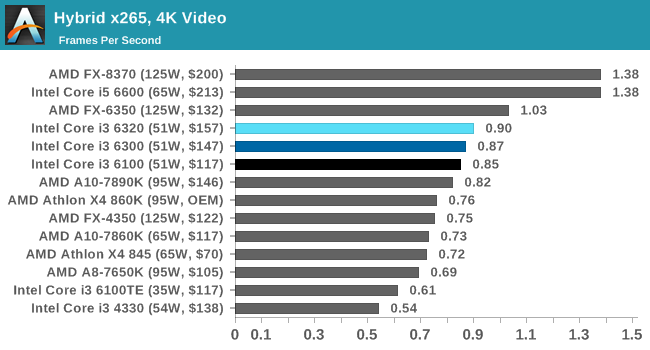
Hybrid is similar to HandBrake, and we again have a regular staircase.
Originally published at https://www.anandtech.com/show/10543/the-skylake-core-i3-51w-cpu-review-i3-6320-6300-6100-tested (Wayback Machine).