
Ten Year Anniversary of Core 2 Duo and Conroe: Moore’s Law is Dead, Long Live Moore’s Law
Core: Performance vs. Today
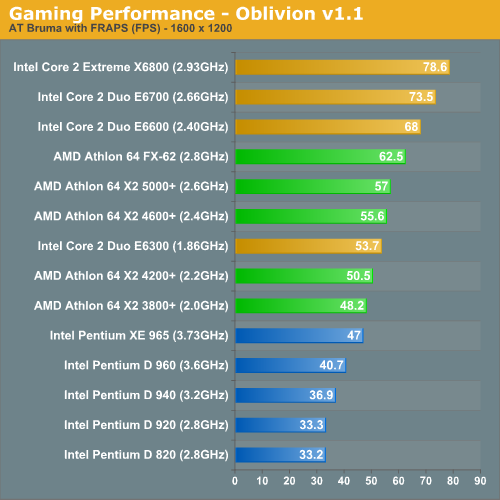
Looking back at Anand’s original review, and at a time where CPU performance made a lot of difference for gaming frame rates at 1600x1200, the conclusion was quite startling.
Intel's Core 2 Extreme X6800 didn't lose a single benchmark in our comparison; not a single one. In many cases, the $183 Core 2 Duo E6300 actually outperformed Intel's previous champ: the Pentium Extreme Edition 965. In one day, Intel has made its entire Pentium D lineup of processors obsolete.
Imagine something like that happening today. (Actually, if you believe what we’ve been told, AMD’s upcoming AM4 platform with Zen and Bristol Ridge might make its current desktop platform obsolete, but that’s a slightly different discussion because of how integrated graphics has adjusted the landscape for CPU focused silicon somewhat.)
That’s Intel vs. Intel though, against AMD it was just as damning.
Compared to AMD's Athlon 64 X2 the situation gets a lot more competitive, but AMD still doesn't stand a chance. The Core 2 Extreme X6800, Core 2 Duo E6700 and E6600 were pretty consistently in the top 3 or 4 spots in each benchmark, with the E6600 offering better performance than AMD's FX-62 flagship in the vast majority of benchmarks.
However, Core 2 Duo has now been out for 10 years. I’ve pulled up some benchmark data from our database to see if we have any matches to compare against processors that cost $214 today. The Core i5-6600 fits our bill perfectly, and there are two benchmarks which match up. I’ve also dotted the graphs with a range of more recent AMD and Intel processors for progression.
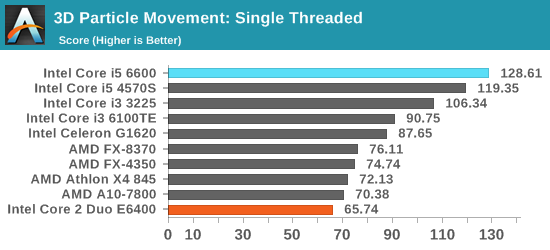
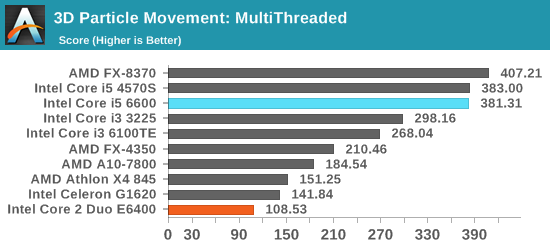
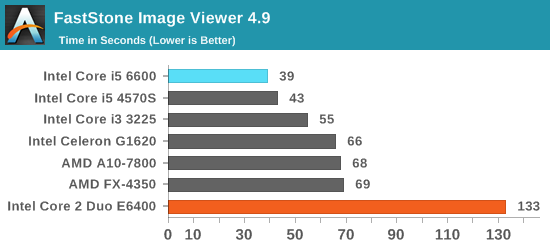
Our 3D Particle Movement is more for idealized synthetic workloads, however FastStone is all about image conversion and favors high frequency, high single threaded performance.
Naturally, modern processors nearing 4.00 GHz have a large advantage over the 2.13 GHz version of Core 2 Duo, as well as multiple generations of improved microarchitecture designs and smaller lithography nodes for power efficiency. However, has any processor family had as much nostalgic longevity as the consumer launch of Core? One could argue that while Core put Intel on top of the heap again, Sandy Bridge was a more important shift in design and as a result, many users went from Conroe to Sandy Bridge and have stayed there.
Originally published at https://www.anandtech.com/show/10525/ten-year-anniversary-of-core-2-duo-and-conroe-moores-law-is-dead-long-live-moores-law (Wayback Machine).