
The NVIDIA GeForce GTX 1080 & GTX 1070 Founders Editions Review: Kicking Off the FinFET Generation
Ashes of the Singularity
Sorely missing from our benchmark suite for quite some time have been RTSes, which don’t enjoy quite the popularity they once did. As a result Ashes holds a special place in our hearts, and that’s before we talk about the technical aspects. Based on developer Oxide Games’ Nitrous Engine, Ashes has been designed from the ground up for low-level APIs like DirectX 12. As a result of all of the games in our benchmark suite, this is the game making the best use of DirectX 12’s various features, from asynchronous compute to multi-threadeded work submission and high batch counts. What we see can’t be extrapolated to all DirectX 12 games, but it gives us a very interesting look at what we might expect in the future.
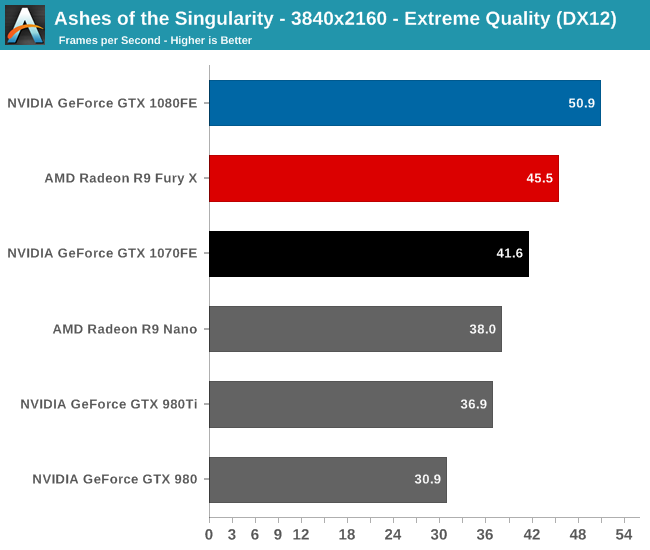
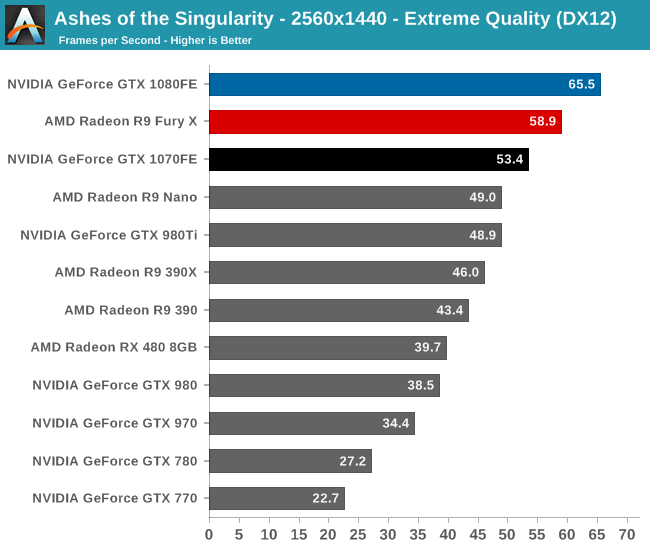
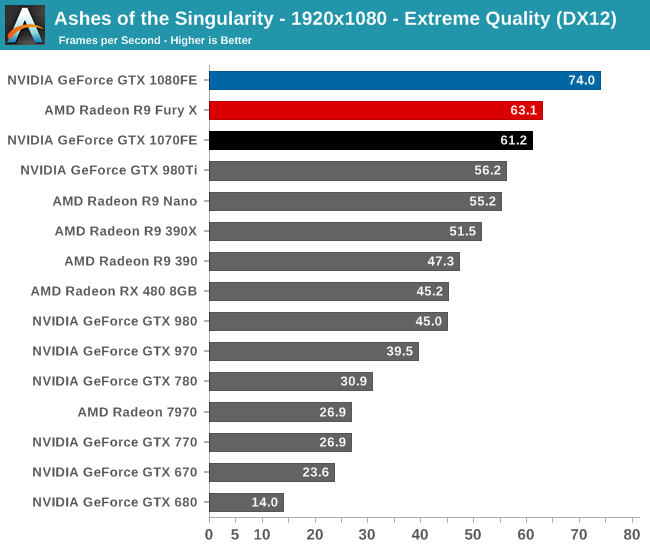
Once again the top spot is uncontested by the GTX 1080. However after that, things become more interesting. On the whole, Ashes is a game that favors AMD GPU over NVIDIA GPUs, and as a result the GTX 1070 does not get to lock in second place. Rather that goes to the last generation Fury X. AMD designs are very ALU-heavy, and I suspect Ashes is capable of putting those ALUs to good use, something most other games struggle with. That said, if we normalized this for price or power consumption, then the Pascal cards would be well in the lead, but it does show that on an absolute basis, GTX 1070 isn’t going to outrun the best of the last-gen cards all the time.
Meanwhile it’s interesting to note that one of the more unusual aspects of the engine behind Ashes is that it’s relatively resolution insensitive. That is, performance only drops moderately as we increase the resolution. This means that we need a GTX 1070 to sustain better than 60fps at 1080p, but that same card is still getting better than 40fps at 4K, a resolution with 4x the pixels.
Finally, looking at our NVIDIA cards on a generational basis, even without their commanding lead, the two Pascal cards show the expected generational gains. GTX 1080 improves on GTX 980 by between 65% and 70%, and GTX 1070 improves on GTX 970 by between 53% and 58%.
Originally published at https://www.anandtech.com/show/10325/the-nvidia-geforce-gtx-1080-and-1070-founders-edition-review (Wayback Machine).