
The Corsair Carbide 400Q Case Review
Conclusion
With the Carbide 400Q, Corsair wanted to create a compact and elegant case that also offers good thermal performance and very low noise levels, all for a reasonable price tag. These are just too many eggs for one basket and a single design cannot possibly excel on all five of those areas. It is the balance between them that matters and we feel that Corsair did a fine job balancing their design to the best possible extent.
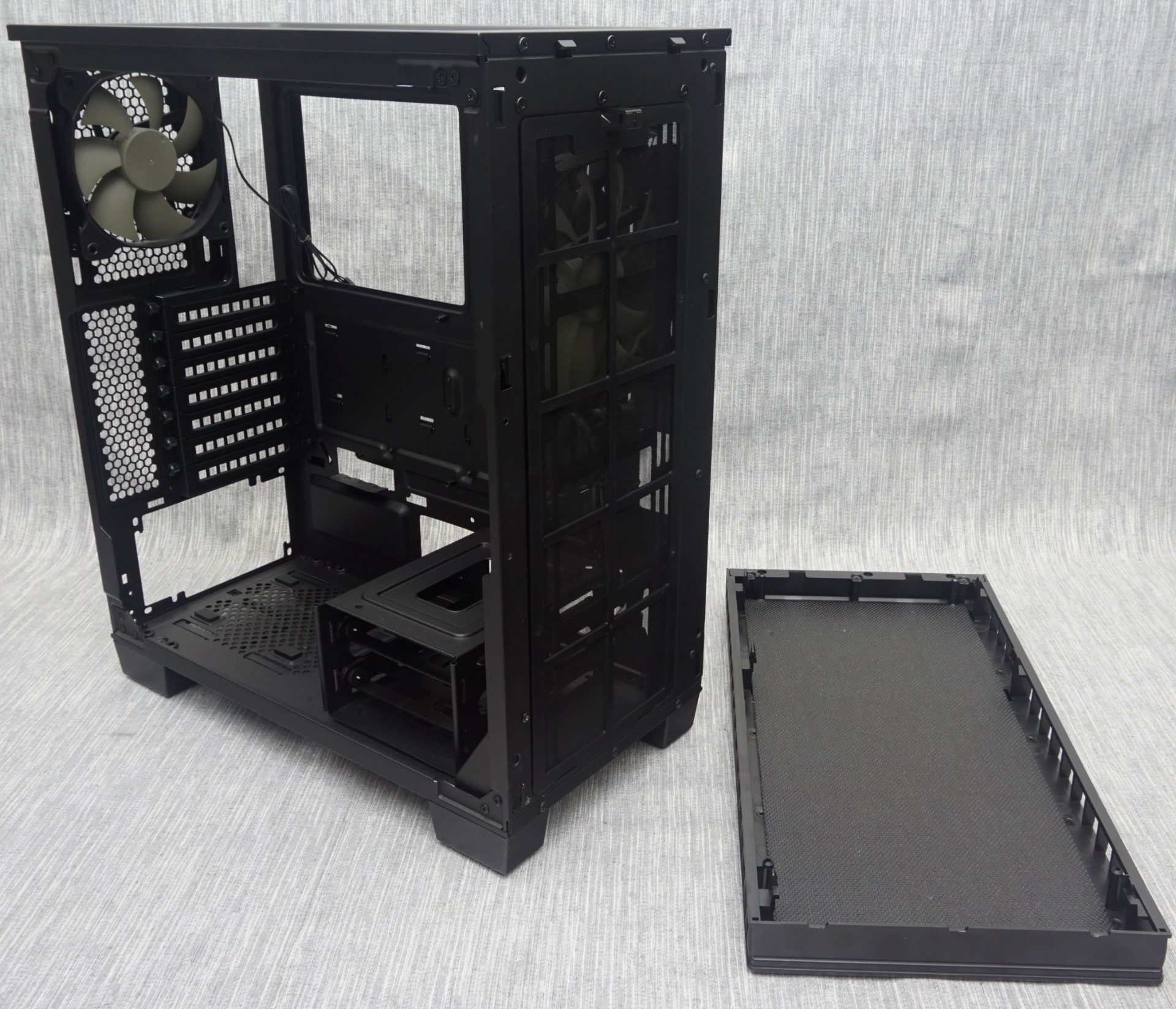
The Carbide 400Q is one of the most compact cases currently available that can support an Extended ATX motherboard, as well as top tier graphics cards and liquid cooling systems. It cannot support many drives but these are more than enough for the majority of home and office users, most of which own a maximum of two or three drives. There is no support for external drives, forcing users who want to work with optical media to go for an external device. This can be a problem for professionals, especially for those that need to receive or share digital material with their customers. Most home users and gamers will not mind, as the bulk of digital material is being transferred online nowadays.
In terms of quality, the Carbide 400Q is very good overall. The mechanical strength of the steel chassis is excellent. It is next to impossible to bent or twist the chassis, even if a lot of force is applied. The paint job is excellent, highly resistant to fingerprints and scratching. Our only concern lies with the plastic frame of the faceplate. The plastics are thick and of very good quality, but it is very tightly attached to the metallic frame of the case, requiring a lot of force to remove it.

With the stock configuration in mind, the balance between thermal performance and acoustics is towards the latter, but the Carbide 400Q still offers thermal performance comparable to that of most ATX tower cases and can easily support a relatively powerful system. If the user wants to, the Carbide 400Q can support even systems with triple graphics cards and liquid cooling, but that would require the removal of the top panel cover and the installation of more and more powerful fans. This would defeat the purpose of buying the Carbide 400Q in the first place, as the end result would probably be a cramped, noisy setup.
In conclusion, the Carbide 400Q is finely balanced between thermal performance, size and acoustics. It currently retails at it MSRP price of $99, which is reasonable for such a case but, in our opinion, if it could have been a little lower it would be more competitive in a crowded market. Nevertheless, the Carbide 400Q can be a very good choice for a typical gaming PC, allowing for relatively low noise levels and good thermal performance using the stock configuration with the case fan thermally controlled by the motherboard.
Originally published at https://www.anandtech.com/show/10276/the-corsair-carbide-400q-case-review (Wayback Machine).