
The PNY CS1311 and CS2211 SSD Review: MLC vs TLC at 15nm
Sequential Read Performance
The sequential read test requests 128kB blocks and tests queue depths ranging from 1 to 32. The queue depth is doubled every three minutes, for a total test duration of 18 minutes. The test spans the entire drive, and the drive is filled before the test begins. The primary score we report is an average of performances at queue depths 1, 2 and 4, as client usage typically consists mostly of low queue depth operations.
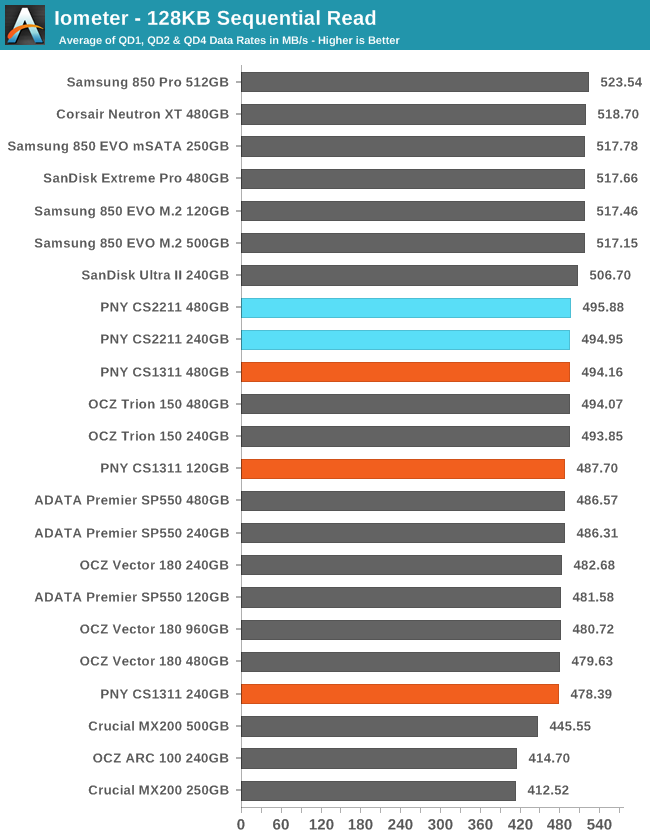
The sequential read performance of the PNY drives puts them all in the second tier of drives with lots of close competition and nothing to complain about. Choice of flash makes little difference to this benchmark: basically everything can saturate the SATA connection by QD4, so the differences here mostly reflect QD1 performance.
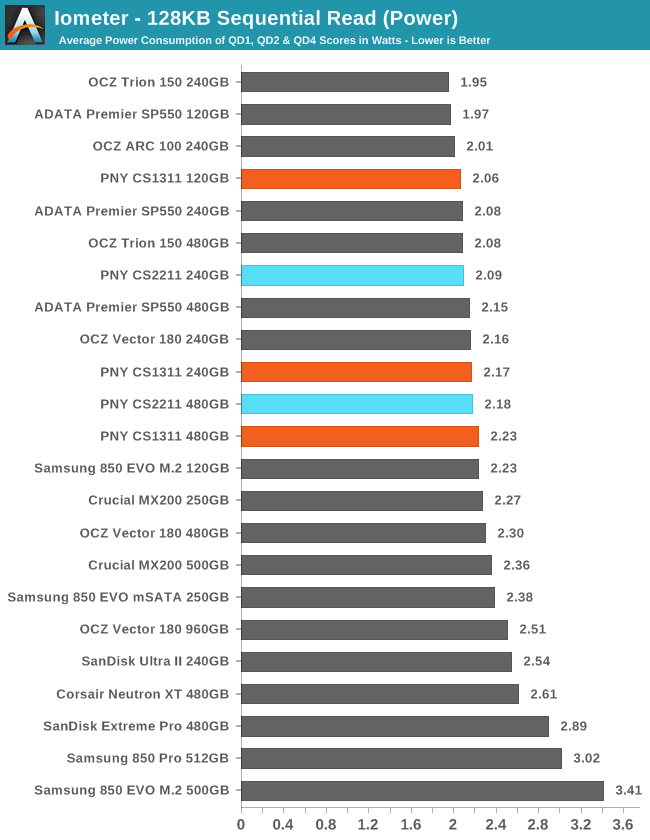
The power consumption shows that the MLC drives are a bit less power-hungry than the TLC drive of the same size (and therefore also more efficient, since the MLC drives are also faster), and that the larger drives are unsurprisingly more power-hungry.
 |
|||||||||
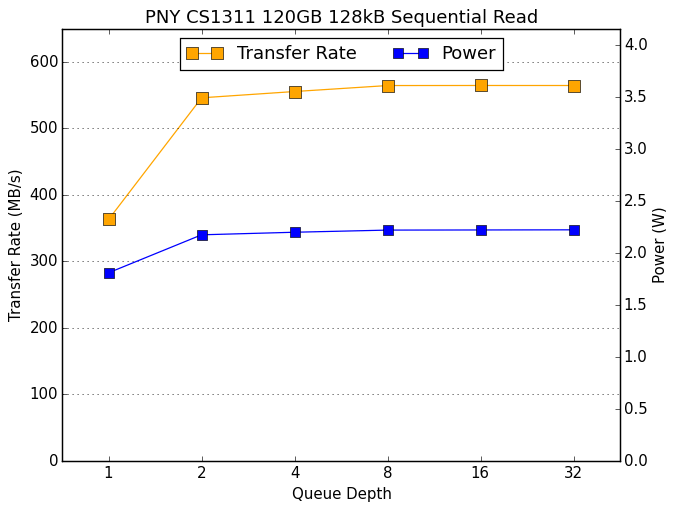
The CS2211 and the largest CS1311 hit full speed at QD2, but the smaller two TLC drives still have a little to gain from QD2 to QD8. Power consumption on all the PNY drives is flat starting at QD2.
Sequential Write Performance
The sequential write test writes 128kB blocks and tests queue depths ranging from 1 to 32. The queue depth is doubled every three minutes, for a total test duration of 18 minutes. The test spans the entire drive, and the drive is filled before the test begins. The primary score we report is an average of performances at queue depths 1, 2 and 4, as client usage typically consists mostly of low queue depth operations.
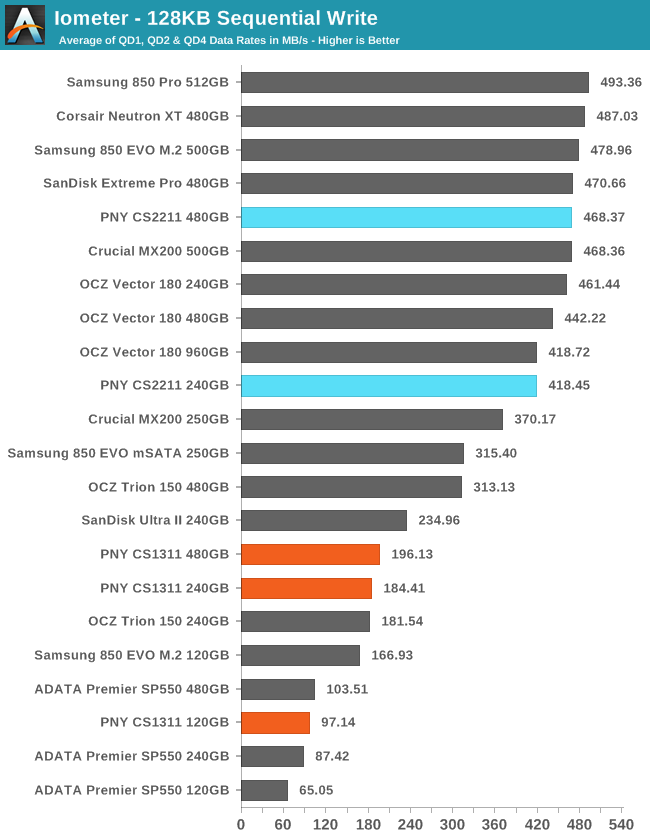
The sequential write test clearly shows the write performance advantage of TLC over MLC, and the advantage of increased parallelism in larger drives. It's interesting that the 480GB CS1311 has such a small advantage over the 240GB despite having the advantage of an 8-channel controller, while the 120GB CS1311 is clearly starved for parallelism.
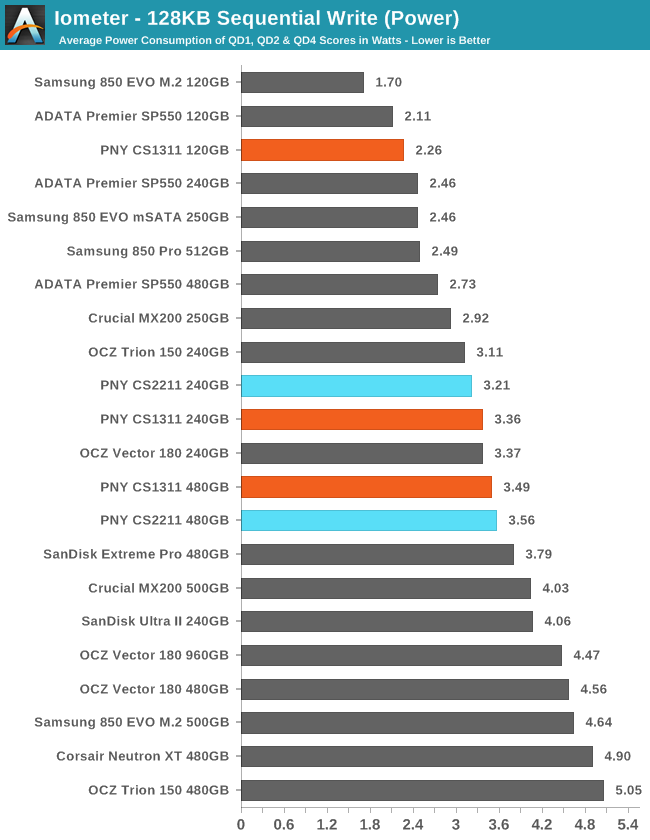
Power consumption during the sequential write test is strongly correlated with drive capacity, showing once again that the higher efficiency of MLC is offset by the higher throughput.
 |
|||||||||
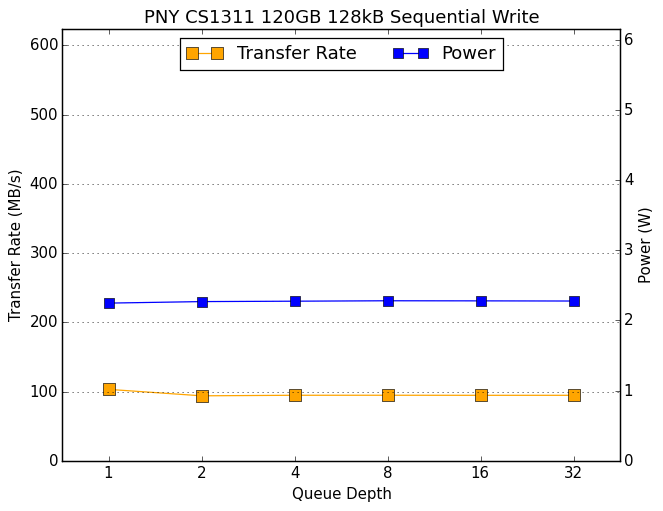
The CS1311 actually drops slightly in performance from QD1 to QD2, but is stable after that. The CS2211 gains significantly from QD1 to QD2 and but scales no further.
Originally published at https://www.anandtech.com/show/10234/the-pny-cs1311-and-cs2211-ssd-review-mlc-vs-tlc-at-15nm (Wayback Machine).