
The OCZ Trion 150 SSD Review
Random Read Performance
The random read test requests 4kB blocks and tests queue depths ranging from 1 to 32. The queue depth is doubled every three minutes, for a total test duration of 18 minutes. The test spans the entire drive, which is filled before the test starts. The primary score we report is an average of performances at queue depths 1, 2 and 4, as client usage typically consists mostly of low queue depth operations.
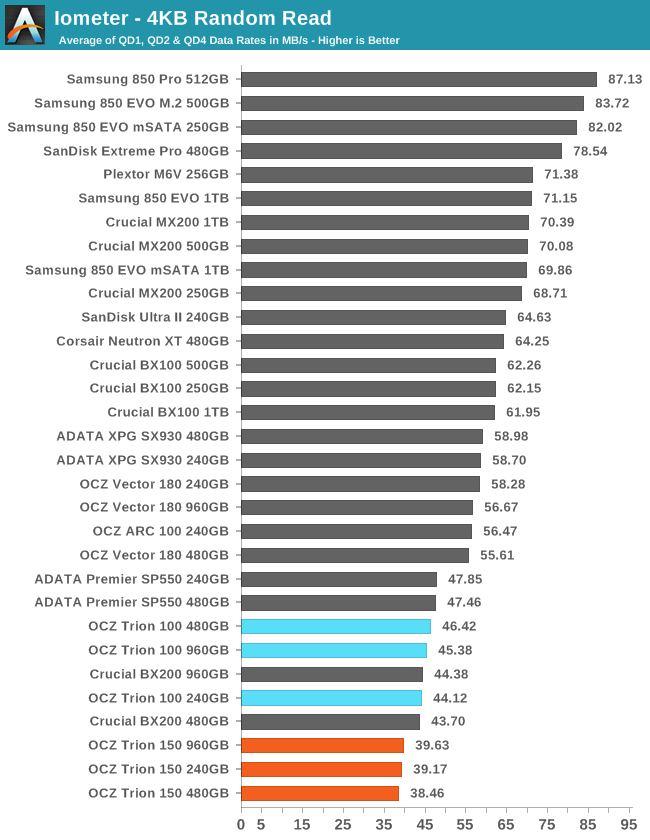
The Trion 150 sets a new low for small queue depth random read speeds, with half the performance of the best SATA drives. This is probably the primary cause of the poorer latency scores seen on the ATSB tests. For context, the QD1 performance of the 480GB Trion 150 is still almost 50 times faster than a 7200RPM hard drive.
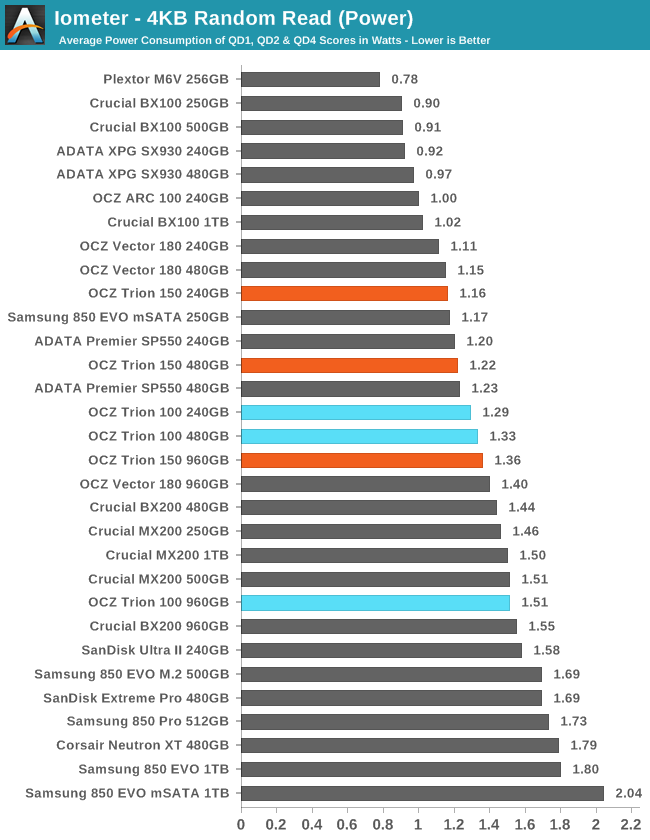
Power consumption has at least decreased in kind with the reduced performance, but the ADATA SP550 manages slightly better efficiency than the Trion 150 and most MLC drives are much more efficient.
 |
|||||||||
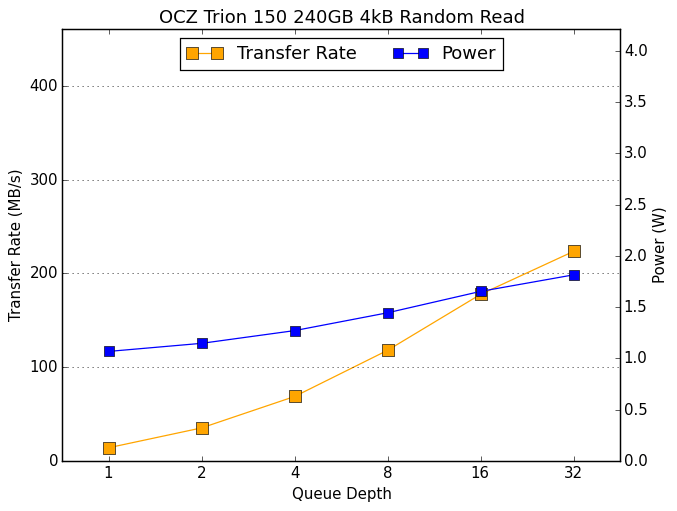
The 480GB Trion 150 doesn't perform quite as well at the highest queue depths as the other capacities, but all sizes perform considerably worse than the competition, especially at high queue depths.
Random Write Performance
The random write test writes 4kB blocks and tests queue depths ranging from 1 to 32. The queue depth is doubled every three minutes, for a total test duration of 18 minutes. The test is limited to a 16GB portion of the drive, and the drive is empty save for the 16GB test file. The primary score we report is an average of performances at queue depths 1, 2 and 4, as client usage typically consists mostly of low queue depth operations.
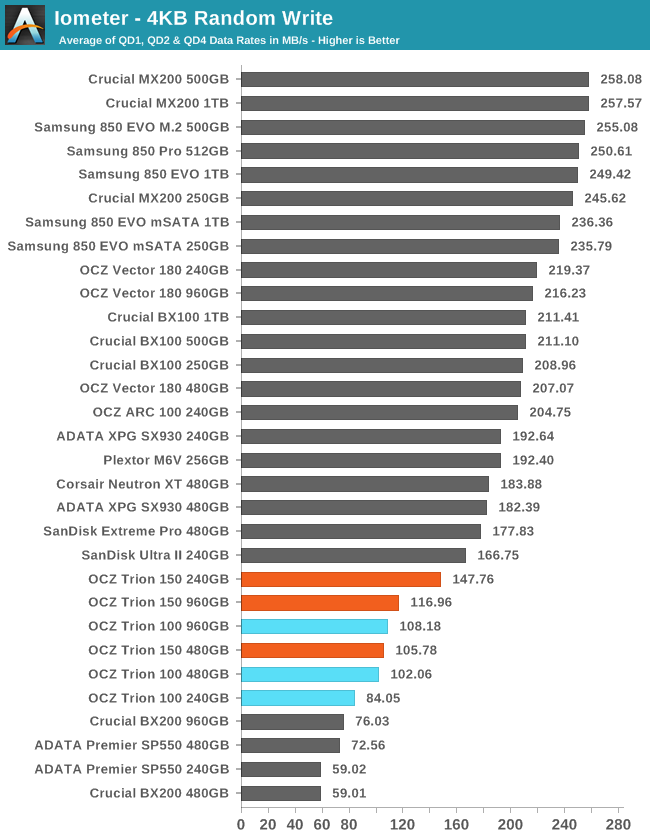
Random write speed on the 240GB Trion 150 got a huge boost over the Trion 100 and even the larger Trion 150s, but they all improved and widened the lead over SM2256 drives.
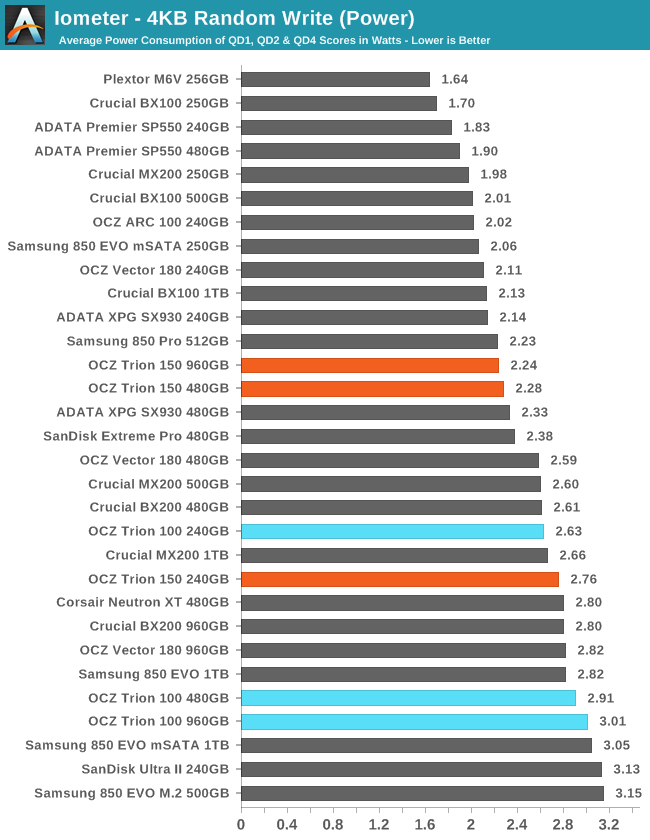
Power efficiency during random writes is much improved. The 240GB Trion 150 draws slightly more power than the 240GB Trion 100, but that's completely justified by the performance jump.
 |
|||||||||
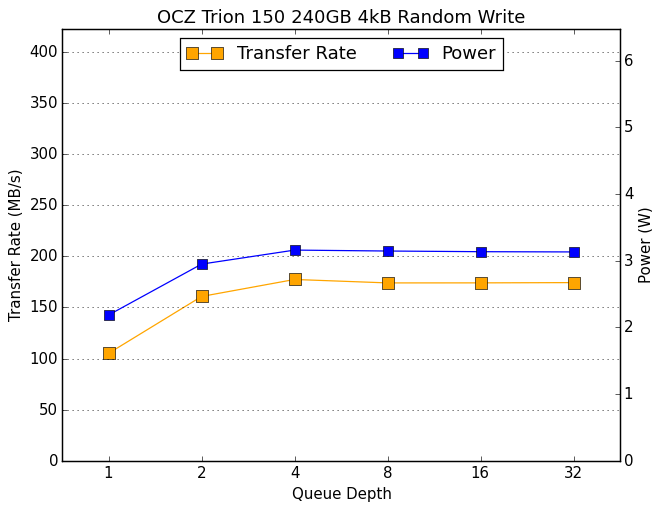
The queue depth scaling behavior is quite odd. The 240GB Trion 150 doesn't change past QD4, but the larger sizes see a huge improvement moving to QD8 and beyond. This can make for some nice benchmark numbers but won't have much real-world impact. At low queue depths the 240GB comes out well ahead. This discrepancy is most likely a difference in the SLC caching configuration between the different models. Whatever the cause, the 240GB drive is making the better choices.
Originally published at https://www.anandtech.com/show/10189/the-ocz-trion-150-ssd-review (Wayback Machine).