
The OCZ Trion 150 SSD Review
Performance Consistency
Our performance consistency test explores the extent to which a drive can reliably sustain performance during a long-duration random write test. Specifications for consumer drives typically list peak performance numbers only attainable in ideal conditions. The performance in a worst-case scenario can be drastically different as over the course of a long test drives can run out of spare area, have to start performing garbage collection, and sometimes even reach power or thermal limits.
In addition to an overall decline in performance, a long test can show patterns in how performance varies on shorter timescales. Some drives will exhibit very little variance in performance from second to second, while others will show massive drops in performance during each garbage collection cycle but otherwise maintain good performance, and others show constantly wide variance. If a drive periodically slows to hard drive levels of performance, it may feel slow to use even if its overall average performance is very high.
To maximally stress the drive's controller and force it to perform garbage collection and wear leveling, this test conducts 4kB random writes with a queue depth of 32. The drive is filled before the start of the test, and the test duration is one hour. Any spare area will be exhausted early in the test and by the end of the hour even the largest drives with the most overprovisioning will have reached a steady state. We use the last 400 seconds of the test to score the drive both on steady-state average writes per second and on its performance divided by the standard deviation.
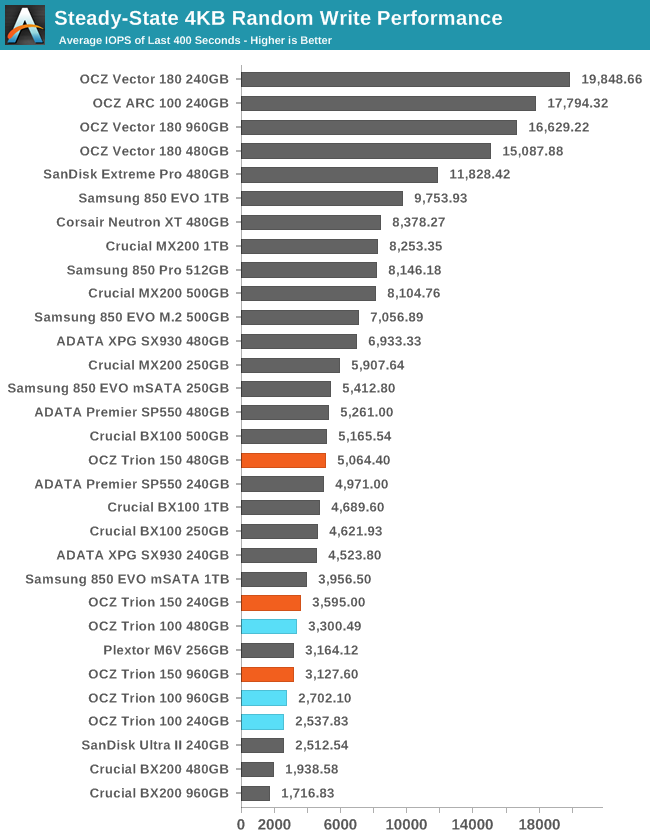
The Trion 150 substantially improves steady-state performance over its predecessor. The middle 480GB capacity is once again the best-performing size by a wide margin.
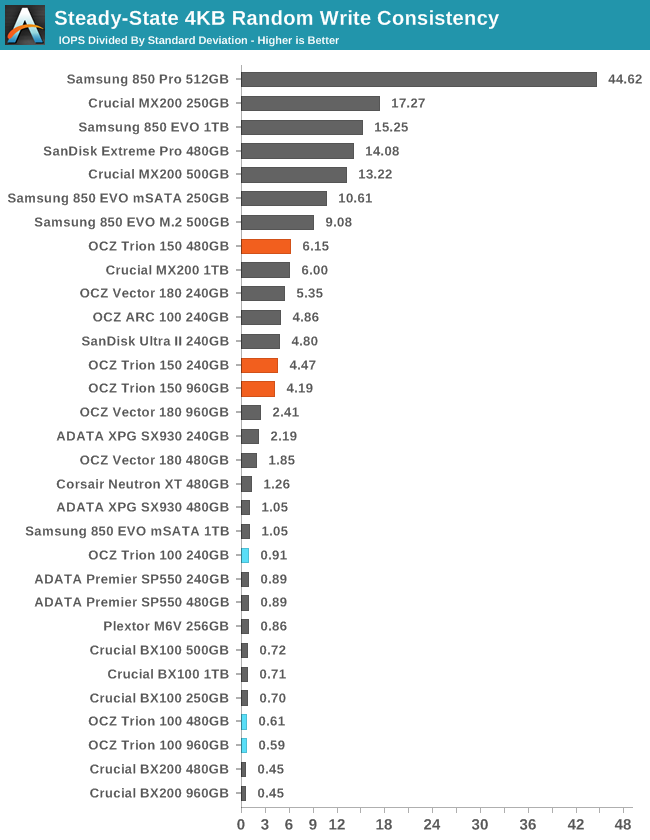
The Trion 150's consistency score has climbed out of the gutter—aided somewhat by the improved average performance, but there's clearly been a major change in behavior for the drive firmware that reduces the variability of write performance. The Trion 150 scores much better than any other budget drive.
 |
|||||||||
| Default | |||||||||
| 25% Over-Provisioning | |||||||||
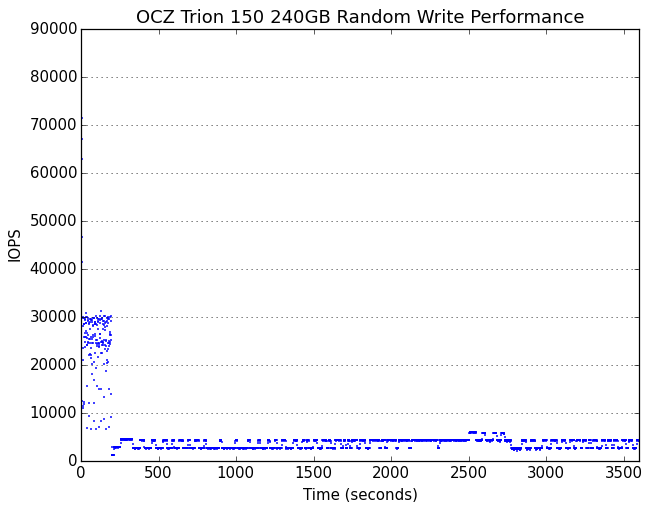
After a very short initial burst of high performance due to SLC write caching, the Trion 150 settles into a pattern of decent but broadly variable performance as it burns through the remaining spare area. Once the spare area is exhausted the behavior changes completely and the drive is very steady, transitioning between a handful of discrete performance levels.
 |
|||||||||
| Default | |||||||||
| 25% Over-Provisioning | |||||||||
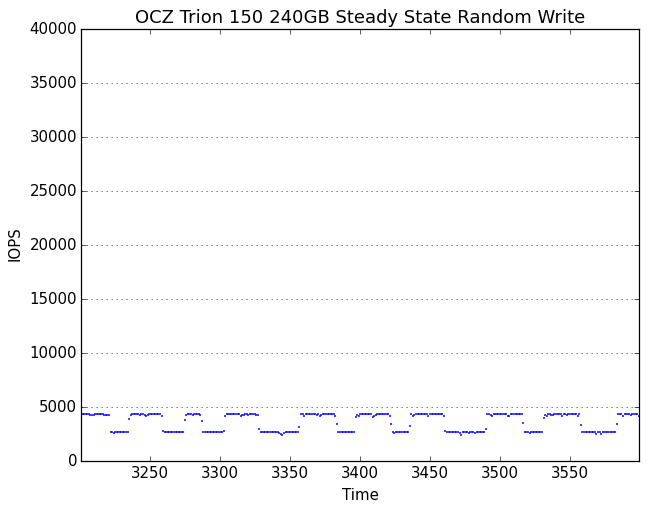
Looking closer at the steady-state phase, the transitions between performance states are very clear and abrupt, and there are no outliers in either direction. The performance with manual overprovisioning is substantially higher and the consistency is only slightly worse. In either case, the consistency is as good as we could ask for and a big improvement over the earlier Trion 100.
Originally published at https://www.anandtech.com/show/10189/the-ocz-trion-150-ssd-review (Wayback Machine).