
The Intel Xeon E5 v4 Review: Testing Broadwell-EP With Demanding Server Workloads
MySQL 5.7.0
Thanks to the excellent repository of Percona, we were able to vastly improve our MySQL benchmark with Sysbench. However due to these changes, you cannot compare this with any similar Sysbench based benchmarking we have done before.
In updating our SQL benchmarking, we first upgraded the standard mysql installation to the better performing Percona Server 5.7. Secondly, we used sysbench 0.5 (instead of 0.4) and we implemented the (lua) scripts that allow us to use multiple tables (8 in our case) instead of the default one. This makes the Sysbench benchmark much more realistic as running with one table creates a very artificial bottleneck.
For our testing we used the read-only OLTP benchmark, which is slightly less realistic, but still much more interesting than most other Sysbench tests. This allows us to measure CPU performance without creating an I/O bottleneck. Our humble S3500 SSDs were fast enough in this scenario.
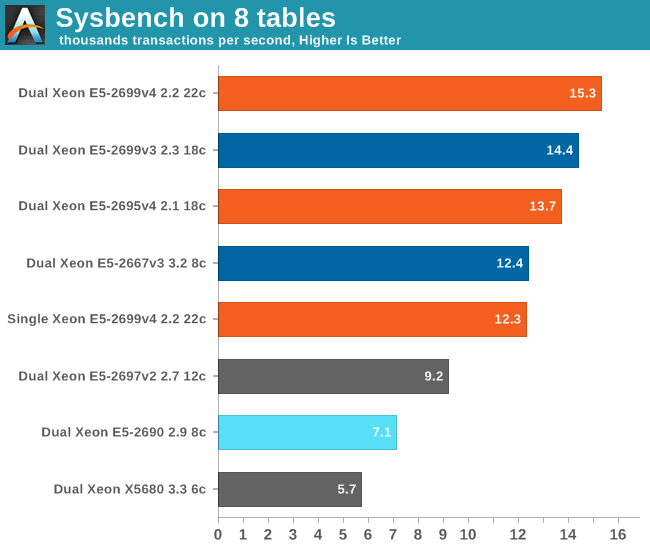
We used to apply all kinds of hacks to get around the limited scalability of both mysql and the way sysbench tested. Any version older than 5.5 could hardly scale beyond 8 cores. It is still not perfect, but MySQL uses the first 22 cores and 44 threads of the Xeon E5-2699 v4 amazingly well. We only get a 24% performance increase if we double the core count again with a second CPU, but we are honestly surprised that MySQL can now make good use of those 88 threads. Thanks to our better testing methods and a more scalable mysql, we can now report that the latest Xeon is capable of doubling the performance of the best Xeon that was launched 4 years ago. Well done Oracle, Percona, and Intel!
Originally published at https://www.anandtech.com/show/10158/the-intel-xeon-e5-v4-review (Wayback Machine).