
The Toshiba Q300 SSD Review: Toshiba Becomes a Retail Brand
AnandTech Storage Bench - The Destroyer
The Destroyer is an extremely long test replicating the access patterns of very IO-intensive desktop usage. A detailed breakdown can be found in this article. Like real-world usage and unlike our Iometer tests, the drives do get the occasional break that allows for some background garbage collection and flushing caches, but those idle times are limited to 25ms so that it doesn't take all week to run the test.
We quantify performance on this test by reporting the drive's average data throughput, a few data points about its latency, and the total energy used by the drive over the course of the test.
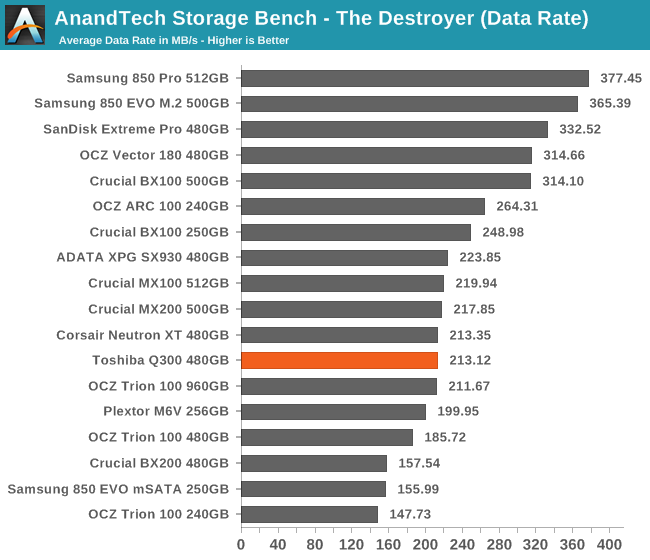
The Q300's average data rate during The Destroyer was slightly better than the Trion 100 480GB, and puts the Q300 around the middle of the pack and well ahead of the Crucial BX200. It's also slightly ahead of the Plextor M6V, a drive that uses MLC flash and prioritizes power efficiency over performance.
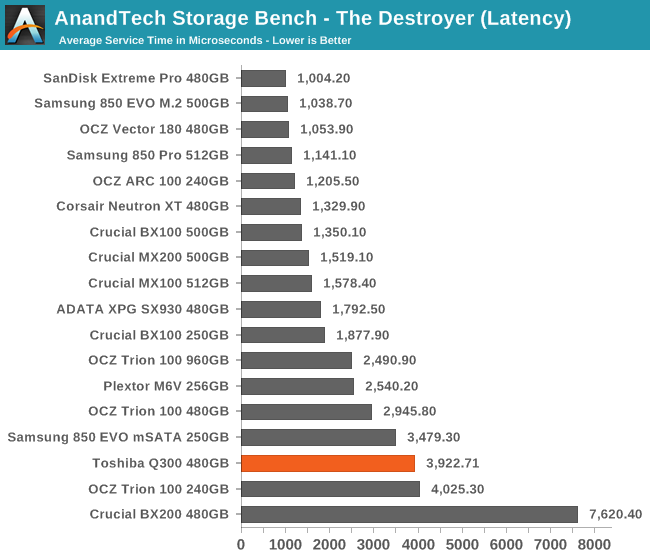
The average service time of the Q300 on The Destroyer is considerably worse than the Trion 100, and near the bottom of the chart. The performance consistency test showed the Q300 as significantly more variable than the Trion 100 before reaching steady state, so this result isn't inexplicable.
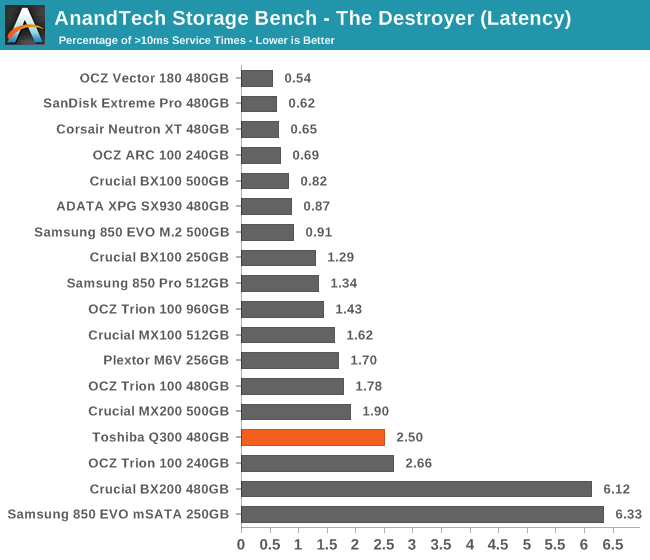
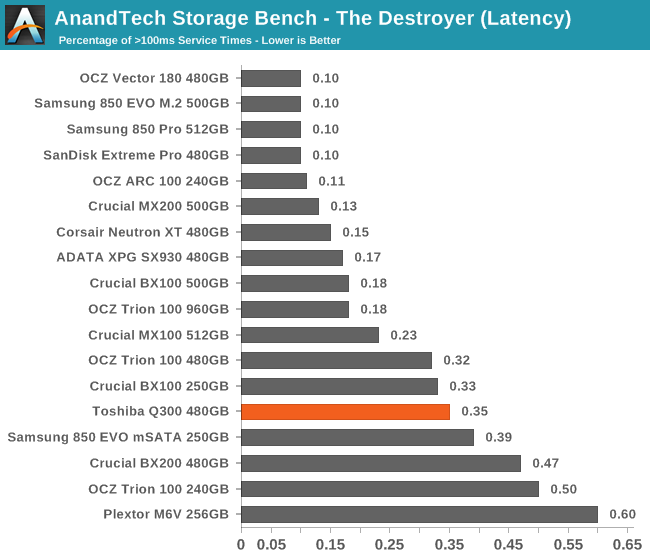
The Q300 has more severe latency outliers than the Trion 100, though neither drive is great at limiting latency.
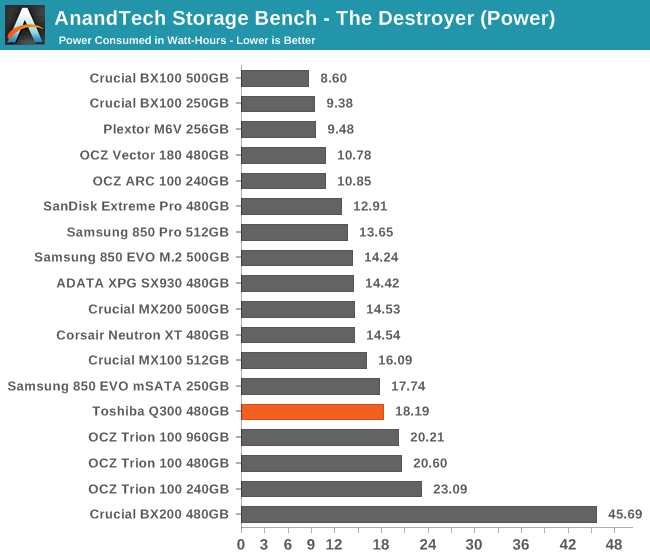
The Q300 shows improved power efficiency over the Trion 100, but the MLC drives are all better.
Originally published at https://www.anandtech.com/show/10084/the-toshiba-q300-ssd-review (Wayback Machine).