
Examining Soft Machines' Architecture: An Element of VISC to Improving IPC
Dealing with Guest ISAs and a Translation Layer
Going back to this architecture diagram, everything up to the global front end is another interesting story as well.
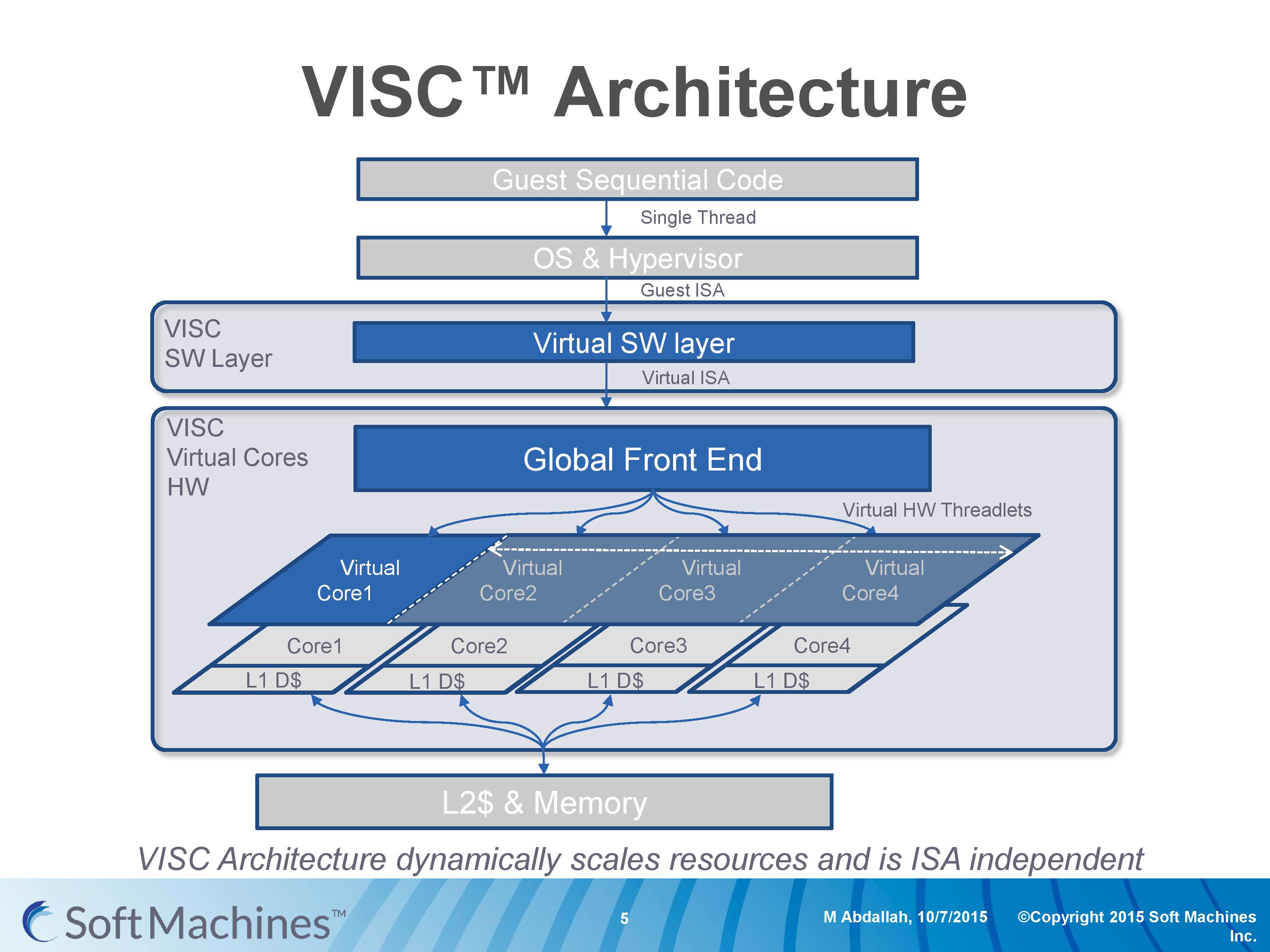
Part of Soft Machines' product package is a low level virtual software layer that will translate a guest instruction set and convert it into the VISC ISA. This is to allow VISC to be used with existing software, and to more easily integrate into current environments rather than trying to establish an ecosystem for a new architecture in 2016. Soft Machines tells us that two instruction sets are supported, one of which will be ARMv8. It was implied that x86 would be the other, although they were reluctant to outright confirm it (ed: x86 translation is likely not to be looked upon fondly by Intel). Meanwhile we were told that writing additional translation layers, while not trivial, can be done and that they plan to support other guest ISAs in future.
So for all intents and purposes, this is a translation layer converting from ARMv8 to VISC. Many companies over the past couple of decades have tried with translation layers – Intel with Itanium, Transmeta to x86, and one of the latest was NVIDIA with Denver, which translated ARM to a custom ISA. Mentioning Itanium, Transmeta and Denver, for those who have followed the industry, might bring a chill down the spine given the very limited success each of these platforms have had. Soft Machines’ CEO was keen to point out that the purpose of the translation layer for VISC is very different to these previous attempts.
The VISC translation layer is designed to be a thin and lean implementation whose main role is to maintain compatibility to the VISC ISA, not to extract performance. Taking Denver as the most recent example, the translation layer there is designed to adjust the ARM instructions into Denver’s ISA and extract instruction level parallelism into the 7-wide design. For VISC, we are told, there is no need to go after performance at this level. The main point at which the VISC design increases performance is at threadlet generation, not in translation and making instruction sequences better fit the VISC hardware. This allows the ARM translation layer to have a less than 5% overhead, according to Soft Machines, and releases a point of contention with previous translation layer designs. As long as the translation layer is 100% compatible, the performance can in principle be extracted at the threadlet level.
This also means, again according to Soft Machines, that any specific compiler enhancement offered by others can also be used when translated. We put it to them that in the case of x86 certain codes are accelerated better on Intel’s compiler than say GCC (a question that arose out of the results we’ll go into later), and we were told that those instruction enhancements by ICC should translate well into the VISC ISA after going through the translation layer.
We asked about the VISC ISA, but were told that more information about this and the core design would be released at a later date as designs progress. We were told that it is a relatively small ISA (as to us sounds like a RISC, which is easier to extract ILP at lower power) with smaller instructions in comparison to ARM and x86. I would assume that this means they are fixed length, but this was not confirmed.
Originally published at https://www.anandtech.com/show/10025/examining-soft-machines-architecture-visc-ipc (Wayback Machine).