
Who Controls the User Experience? AMD’s Carrizo Thoroughly Tested
How to Iterate Through Design
While AMD’s Carrizo is still based on this Bulldozer design, it represents the fourth iterative update, called Excavator, which is now produced at the 28nm process node compared to the 32nm original design. At each juncture from Bulldozer (rev1) through Piledriver (rev2) and Steamroller (rev3) to Excavator (rev4), AMDs goal has been the same as most other semiconductor manufacturers - produce a list of fixes that provide the most benefit for the least amount of time, then work through that list. This is not an uncommon procedure for iterative updates, and in itself retains the logical thought of improving the design as much as possible.
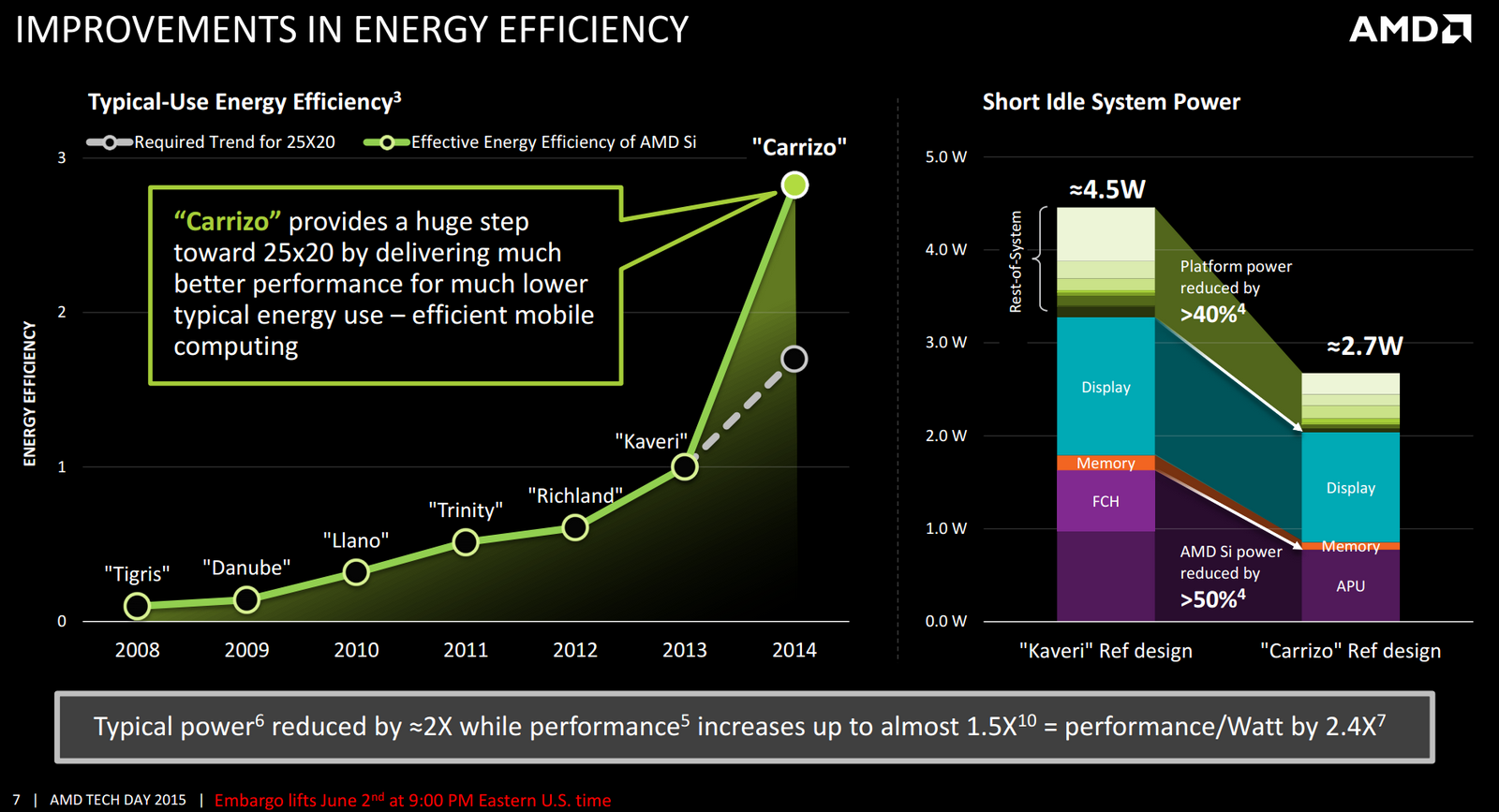
What this method perhaps misses are the bigger leaps in design philosophy where shifting fundamental paradigms can have a bigger impact on key properties of the product, but these changes in philosophy often carry the burden of increased risk and cost, where failure is seen as a waste of resources. Nevertheless, the Excavator core and the Carrizo design, according to AMD, implements a significant number of fundamental paradigm shifts compared to previous revisions, and as a result Carrizo behaves differently in a large number of key metrics. The base design underneath is still inherently the Bulldozer concept, however the 'skunkworks' style adjustments, according to AMD, significantly improve the power consumption, the single core performance and the potential battery life over previous AMD processor designs in mobile segments. All current gains on this design have only come from AMD, lacking independent verification.
For a more detailed look at AMD's Excavator design, with high density libraries and power management, read our run down of Carrizo's technology from our launch article here.
Gaining OEM Support
Aside from the processor itself, the image of AMD based devices, especially in the mobile segment, is not overly positive. As mentioned above, there are two sides to this story - original equipment manufacturers whom use AMD processors in their designs have to be confident that it will provide a level of performance suitable for the experience they expect the consumer to have. Similarly, the end user must also receive a platform that benefits the price point purchased and retains a level of quality consistent with providing a good experience. Former poor experiences can be a heavily influence in future purchasing decisions, and those with a negative opinion require a fundamental design change or significant external recommendations in order to make a change against a gut feeling. If a user keeps getting a poor design, regardless of which side of the fence is responsible (or both), both will be negatively affected, and sometimes one more than the other.
This applies to both consumers and business users, the latter of which is often down to individuals at companies making recommendations based on brand and business sense. If a business buyer insists on Dell, for example due to a long term support contract, they will source the most appropriate Dell device out of the range based on research and that gut feeling. In order for a semiconductor company to be competitive in this space, they need to work closely and extensively with the business OEMs to build devices that facilitate the experiences required with a level of industrial design that enables the appropriate experience. It is not difficult to search online for details of users that are disgruntled with devices from both Intel and AMD, particularly in areas such as industrial design of the device, performance, battery life, temperature and quality.

While Intel has a number of arms with partners based on the success of the Core architcture over the last decade, AMD’s stable of partners is not so large. AMD has three top tier partners – HP, Lenovo and Toshiba – all of whom are represented in this report. Like many other notebook manufacturers in the industry, all of these three are well known for some models but hounded on others, especially those at the bottom of the price stack or due to unique sets of security principles. As mentioned previously, HP focuses a lot on the Enterprise space with items like the Elitebook line, but if personal experience is anything to go by, consumer use of Elitebooks has declined. Toshiba meanwhile suffers from the race-to-the-bottom syndrome where sometimes a simple $30 upgrade can make the difference, and Lenovo’s recent software issues have been well documented. AMD works with these three partners the most, such that when they score a big contract (such as 30,000 units with HP for Dr. Pepper/Snapple) it is actually a big contract for AMD.
Originally published at https://www.anandtech.com/show/10000/who-controls-user-experience-amd-carrizo-thoroughly-tested (Wayback Machine).